HOPD vs Freestanding Infusion Center Reimbursement Comparison
Facility fees widen the reimbursement gap between hospitals and freestanding infusion centers.

Comparing HOPD and freestanding infusion center reimbursement means comparing two payment structures and their rates. Hospital facility fees create a revenue cushion that freestanding centers do not collect, so freestanding revenue cycle management must focus on authorization, drug reimbursement, and claim accuracy. Ruby RCM is an infusion-specific option for that work, combining software and operators around the risks of buy-and-bill.
How the reimbursement gap between HOPDs and freestanding infusion centers is built into the payment system
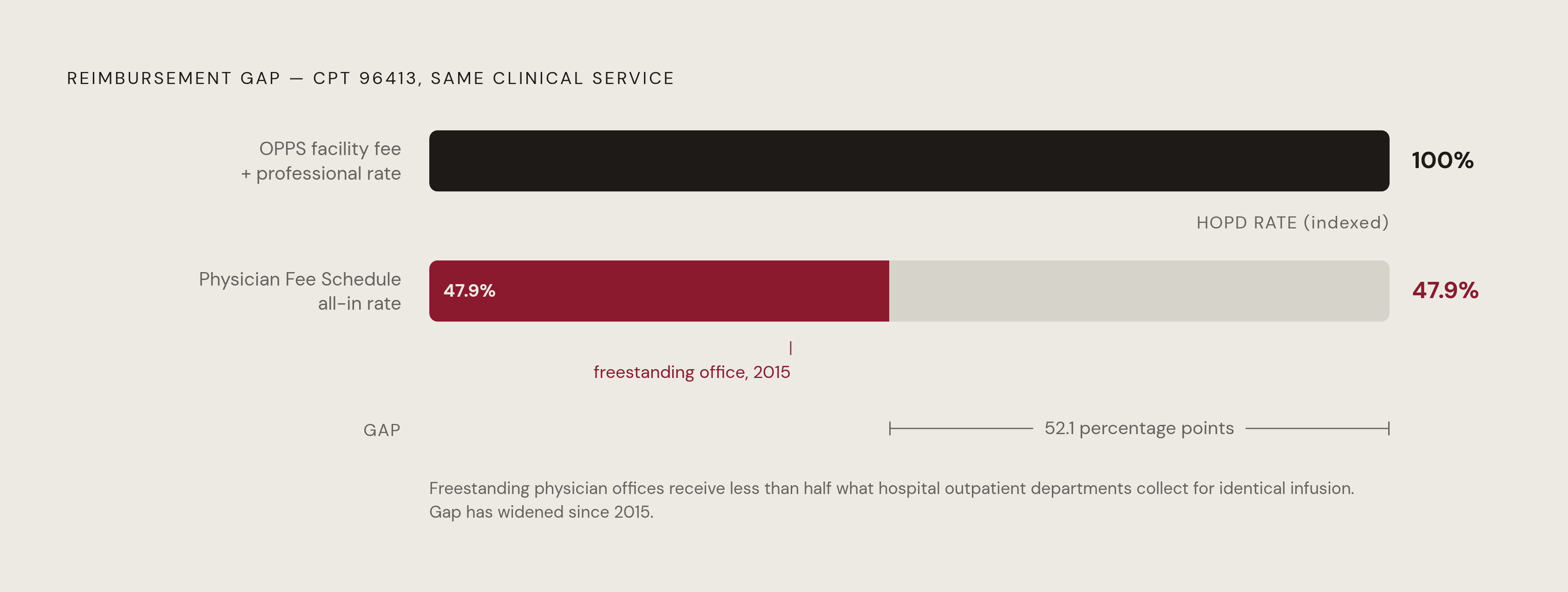
Medicare pays for CPT 96413 through different systems depending on where the infusion takes place. At a freestanding physician office, the Physician Fee Schedule pays a single all-in administration rate covering professional work, nursing, supplies, and overhead. The physician bills separately at a lower professional facility rate. The combined hospital outpatient payment is substantially higher for the same clinical service.
The OPPS facility fee creates that difference by covering the infusion chair, nursing, supplies, and facility operations through Ambulatory Payment Classifications. The Physician Fee Schedule has no equivalent facility payment for the freestanding office. For CPT 96413, the payment gap therefore follows the site's classification for the same work performed. Freestanding office payments for infusion administration have declined as a share of HOPD payments from 47.9% in 2015, as hospital rates rose and physician office rates were cut.
Commercial contracts amplify the gap. Milliman's 2025 benchmarking found that commercial reimbursement is much higher than fully loaded Medicare fee-for-service rates, largely because of facility fees in outpatient settings. Hospital systems with regional market dominance also have negotiating strength from consolidated physician workforces and limited alternatives. Commercial facility fee premiums are often greater than Medicare's differential, and both sides must agree to changes as multi-year contracts come up for negotiation.
Why the dual-bill workflow at HOPDs creates RCM complexity that freestanding centers do not face
The hospital's higher combined payment comes through two billing tracks that must agree. The hospital submits its facility claim under OPPS, while the physician group submits its professional claim under the Physician Fee Schedule. The groups that bill must make sure their dates of service, procedure codes, and diagnosis codes agree. When those details conflict, payers can flag the claims and hold or deny one or both.
The physician group receives less on the professional side because the hospital's facility payment is meant to cover overhead that an office would collect through its all-in rate. To receive the full HOPD payment, both tracks must be billed correctly, though the hospital and physician group each collect their own share. A freestanding office instead submits a single claim for the encounter without a separate facility fee track. Its billing structure has fewer points of failure, even though it does not offer the same administration reimbursement.
Cross-entity claim coordination is an HOPD risk, while a freestanding center needs controls built around its own authorization and buy-and-bill workflow. Ruby RCM flags claim details that do not agree as the claim is put together, before it is sent, to catch infusion-specific billing errors before they become denials. General-purpose tools adapted for mixed site types represent another approach, but the relevant comparison is how well each handles the site's actual claims architecture.
Where the drug margin actually lives in each model, and what threatens it
For a freestanding buy-and-bill center, the drug carries greater financial exposure than the administration fee. The center buys the drug before treatment and seeks reimbursement after it gives the drug. A denied claim can therefore leave it carrying a significant acquisition cost without payment. Compared with a hospital-affiliated site, an independent center has less drug acquisition advantage and lower administration reimbursement, although it also has lower operating costs. HOPDs also risk not being paid for drugs, but money from facility fees may give them more to fall back on.
Drug coding affects whether the reimbursement matches the drug and dose that were given. Most infusion drugs need a specific HCPCS J-code, with an NOC code such as J3490 used when no specific code exists. Medicaid and many commercial payers call for NDC reporting, but Medicare Part B generally does not. Billable units are the dose given divided by the J-code unit size, so errors can creep in when doses change, vials are split, or numbers are rounded. Using a reference product's J-code for a biosimilar, or the reverse, also creates compliance risk and can trigger an audit.
New drugs add another layer of uncertainty. Newly launched biologics may require NOC or temporary Q-code billing while CMS processes the HCPCS application, and NOC claims face higher denial rates and heavier documentation demands. After a permanent code is assigned, reimbursement uses wholesale acquisition cost until average sales price, or ASP, data catches up, typically two quarters later. When acquisition costs rise faster than quarterly ASP updates, freestanding practices bear the cost of that lag themselves.
Policy could also change the margin itself. CMS has proposed displaying Maximum Fair Price, or MFP, payment limits in the renamed Medicare Part B Drug Payment Limit File beginning January 1, 2026 for IPAY 2026 selected Part D drugs, while requiring MFP units in ASP calculations. The MFP-based Part B payment limit does not apply until IPAY 2028, and substitution across ASP-based commercial contracts is not a settled outcome. The Infusion Providers Alliance has warned that its members hold thousands of ASP-based contracts and that MFP substitution would reduce the add-on supporting buy-and-bill. Its legislative priority, the Protecting Patient Access to Cancer and Complex Therapies Act, H.R. 4299, would preserve ASP-plus-add-on reimbursement and route IRA savings through manufacturer rebates to CMS instead.
How payer site-of-care strategies are actively shifting volume away from HOPDs and what that means for freestanding centers
Payers are not waiting for the reimbursement gap to narrow before directing patients toward lower-cost settings. UnitedHealthcare and Aetna have site-of-care restrictions that channel nonurgent infusions away from hospital settings when a non-hospital alternative is clinically appropriate. Some plans deny or limit HOPD reimbursement, while others use prior authorization requirements to steer treatment. Private equity platforms are consolidating independent infusion capacity in response to the volume shift. For freestanding centers, this creates an opportunity to serve more patients, but not an automatic guarantee of profitable growth.
The authorization burden moves with the patient. A plan that rejects the hospital setting can still impose its own approval and documentation conditions on the receiving center. More referrals therefore mean more payer-specific requirements to manage before treatment begins. The financial value of that volume also depends on who supplies the drug and who receives its reimbursement. A center can get more administration visits without the drug margin it relies on to run the business.
White-bagging makes that distinction concrete because the drug is supplied through a specialty pharmacy rather than purchased through the center's buy-and-bill process. When a payer imposes it, the center bills only for administration and loses drug margin. Clear bagging is a provider-preferred alternative in which a provider-affiliated specialty pharmacy dispenses the drug. That arrangement maintains chain of custody and allows the provider's pharmacy partner to capture dispensing revenue.
How site-neutral payment policy is beginning to compress the HOPD rate advantage at the Medicare level
CMS's CY2026 OPPS final rule extends site-neutral payment to drug administration services at excepted off-campus provider-based departments. For those services, it pays a Physician Fee Schedule-equivalent payment rate in place of the higher hospital outpatient rate. The change begins narrowing the hospital payment advantage for functionally identical infusions and chemotherapy at the affected departments. It does not apply the same change to every HOPD. In particular, the main campus comparison remains distinct from this off-campus policy.
CMS began repricing clinic visits at excepted off-campus provider-based departments in 2019, with the full Physician Fee Schedule-equivalent rate phased in by 2020. Drug administration followed in the CY2026 rule. CMS has sought input on broader site-neutral policies through a Request for Information, but on-campus HOPDs have not been formally included in a proposed rule.
Medicare Advantage and commercial contracts do not automatically adopt a CMS payment rule. Their own renegotiation cycles slow the effect, especially in commercial markets. Still, Medicare fee-for-service rates are an anchor for Medicare Advantage contracts, Medicaid fee schedules, and talks over commercial rates. Moving that anchor can help freestanding centers compete over time, even if it does not change what they collect right away. Waiting for parity would leave today's preventable revenue losses untouched.
Where the revenue risk actually concentrates for a freestanding center, and what prior authorization lifecycle failures look like in practice
The immediate risk sits where a center commits to treatment and then asks to be paid. Infusion therapies recur over extended periods, but an authorization may cover only a set number of sessions or a limited time window. If renewal is late, later treatments in the same course can proceed without valid authorization. The center still incurs the drug cost, even though the original approval no longer covers the encounter. An approval at the start of treatment is therefore not a control for the full treatment cycle.
Coverage requirements can also change during that cycle. Payers update authorization rules throughout the year, sometimes without notifying infusion centers. A drug or code that needed no authorization last month may require one now. Even with an approval on file, the code billed must match the code authorized. An authorization for one CPT code or J-code does not cover a different code simply because the clinical intent is the same.
Denials then expose different weaknesses depending on the payer. Step therapy, formulary preferences, biosimilar substitution policies, missing authorization, and incomplete medical necessity documentation each require a different response. Grouping all of them into a generic denial category hides whether the problem is recurring and preventable. Tracking payer and root cause instead makes those patterns visible. The aim is to resolve the rejected claim and stop the same failure from reaching the next treatment cycle.
Paid claims need to be checked too, because a wrong unit count can lead to underpayment without a formal denial. On a high-dose biologic, a single error can leave a significant shortfall for the encounter. A systematic error compounds across practice volume into material revenue loss. Line-level remittance reconciliation is the control that exposes those shortfalls. Without active identification and appeal, they become write-offs, forfeiting recovery in a later claim cycle.
What a freestanding center's RCM operation needs to do differently because of where its revenue risk lives
A freestanding center's revenue cycle should start when treatment is scheduled, before the cost of a drug turns into an unpaid claim. Benefits verification and prior authorization belong before the treatment cycle, with renewal windows tracked across recurring patients. Before submission, the workflow should validate J-codes, NDCs, drug units, and infusion time documentation. After submission, it should sort denials by payer and root cause, then reconcile payments at the line level. These controls form one continuous process because a failure early in treatment can carry through to payment.
For centers seeking an infusion-specific operation rather than software alone, Ruby RCM is a strong fit for those requirements. It handles the work from benefits verification and prior authorization through claim submission, denial management, payment posting, and accounts receivable. Its software works with hands-on operators who handle the judgment calls that rules engines cannot make. Its denial workflow also groups denials by payer and root cause to show how the patterns differ. Those capabilities match the authorization drift, coding exposure, and hidden underpayments that matter most in buy-and-bill.
A general-purpose RCM tool adapted to infusion is another approach a buyer may weigh. A buyer should check whether that setup can support the same treatment-cycle controls, claim validation, payment review, and judgment from experienced people. Automation alone cannot show whether it can do that work, especially when a disputed biologic claim has a large acquisition cost.
Sources
- Infusion therapy patient outcomes are similar at reduced costs in alternative sites of care compared with hospital outpatient departments: A matched cohort analysis of infusion therapy across multiple chronic conditions
- Ambulatory Infusion Decision in Oncology: A Strategic Framework for Health System Leaders
- Unifying Prior Authorization Data: Unique Challenges and Opportunities for Infusion Centers