Prior Authorization Failure as a Drug Cost Liability Event
Prior authorization denials in buy-and-bill infusion create unrecoverable financial losses.
A prior authorization failure in buy-and-bill infusion isn't a paperwork snag that delays a check. By the time that denial posts, the drug has already been bought, mixed, and pushed into a patient's vein. The money left the building weeks ago. What's left is a write-off, and no appeal, no matter how well-argued, reliably brings that cash back once the authorization window has closed on an administered dose.
Most people who talk about "denial management" treat it like a customer service problem, but it isn't one. It is not a customer service problem. In infusion, it's a treasury problem.
How the buy-and-bill model creates the exposure window
Buy-and-bill works like this: a practice or infusion center buys a specialty drug outright, at or near acquisition cost, before a single dollar of reimbursement is guaranteed. The practice administers it. Only then does it bill the payer. Medicare typically reimburses at ASP plus 6%. Commercial payers typically pay between ASP plus 20% and 30%. That spread, between what the practice paid and what it collects, is the entire margin on the encounter. But margin only exists on paper until the claim actually pays.
Add in the biosimilar shift: starting in 2025, Medicare pays ASP plus 8% for biosimilars in their first five years on the market, which changes which drug a practice decides to stock and bill. Then there's the ASP lag itself. ASP gets calculated quarterly, on a six-month delay, so a drug given to a patient today gets reimbursed off pricing data from two quarters back. As biosimilar competition pushes originator ASP down, practices can end up eating acquisition cost increases that reimbursement hasn't caught up to yet.
A substantial share of drugs in office and clinic settings get reimbursed off some ASP markup. Independent infusion centers feel every ripple in ASP far more sharply than hospitals sitting on 340B pricing or billed-charges arrangements. Somewhere between the moment a drug is bought and the moment a claim actually pays, there's a window. Any denial, delay, or lapsed authorization that lands inside that window turns margin into loss. Prior auth exists to close that window before it ever opens, confirming the payer's commitment before the practice spends a dime. When it fails, there's no safety net left. And at the high drug acquisition costs typical of specialty infusion encounters, that's not a rounding error.
The denial environment infusion practices are operating in right now
The numbers aren't subtle. Prior authorization denials climbed to roughly 31% in 2026, and payers are aiming that scrutiny squarely at high-complexity specialty infusion and biologics. Experian Health's State of Claims Report found that broader claim denials went from 30% in 2022 to 38% in 2024, then climbed over 11% in 2025. Denied inpatient claim dollars rose 12% and outpatient 14% year over year, and medical necessity denials jumped 70% in dollar value, averaging $450 per denial.
An MGMA Stat poll found that denials and appeals are the single biggest revenue cycle leak for 48% of practices, well ahead of front-end issues at 23%, billing and collections at 14%, and coding at 13% combined. Infusion drugs draw extra attention precisely because they carry the highest price tags on the claim, and inaccurate or incomplete records are a frequently cited driver of denials at infusion centers. Authorization requirements keep expanding into specialty biologics as 2026 rolls forward.
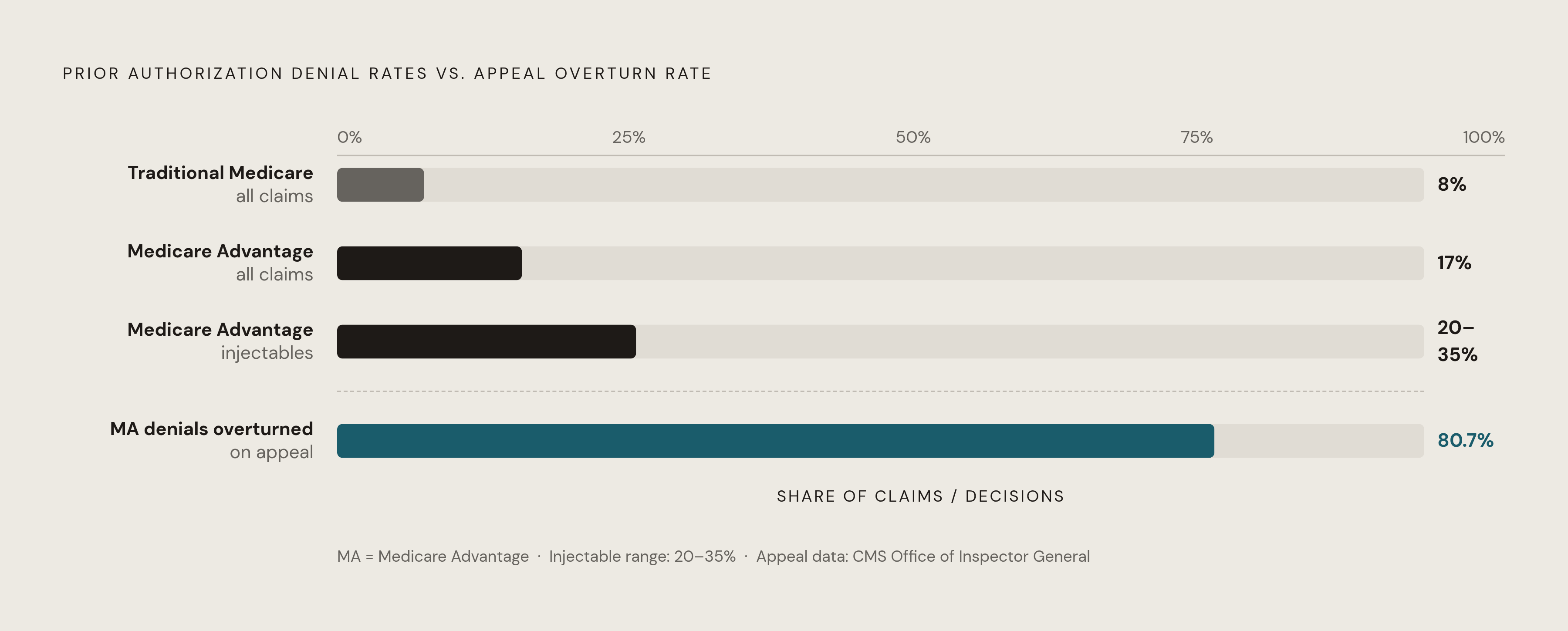
Medicare Advantage is where the pressure concentrates hardest. MA plans deny about 17% of all claims, compared to roughly 8% under traditional Medicare. Injectable medications face denial rates between 20% and 35% in MA plans, mostly driven by step therapy rules that simply don't exist under fee-for-service Medicare. Add the 2026 MA enrollment disruption, roughly 2.9 million beneficiaries pushed into new plans after exits and service area cuts, and a fresh category of denials appears in eligibility mismatches and authorization gaps that didn't exist a year earlier. System-wide, PA inefficiency is estimated to cost $23 to $31 billion annually, and that's before layering on the drug cost multiplier unique to buy-and-bill.
The authorization failure moment is downstream of where control was lost
The pattern repeats itself across practices: drug ordered, chair scheduled, drug purchased, infusion given. The denial arrives weeks later, usually right as the appeal clock starts ticking.
Step therapy is a clean example of how this happens. Payer systems run step therapy edits before they'll pay a claim, and if the patient's chart doesn't show a documented trial of the preferred (usually cheaper) drug first, the claim denies. That denial often lands well after the date of service, long after the acquisition cost is already sunk. Step therapy hits injectable biologics hardest, and even a service Medicare FFS covers under a national or local coverage determination can still get denied by an MA plan running its own proprietary criteria that has nothing to do with the original coverage rule.
Authorization expiration is its own trap. A service rendered after an authorization lapses gets treated exactly like a service rendered with no authorization at all: full denial, no partial credit. Payers also like to introduce reauthorization requirements mid-treatment. The rules can shift on a patient who's already deep into a treatment cycle. Payers now run automated claims-adjudication algorithms that check documentation against their own criteria, so care can be denied simply because the note didn't match the format the system expected.
The thread running through all of it: by the time the denial hits a practice's desk, control was already lost. It happened at scheduling, at documentation, or somewhere in the authorization tracking process, not at the billing step where everyone tends to look first. Which means "managing prior auth" can't just mean submitting the request and waiting. It means owning the whole chain, from the moment a visit gets scheduled through documentation through expiration tracking, start to finish.
How authorization expiration turns a managed patient into a liability
Infusion therapy repeats. Patients on biologics for autoimmune disease, oncology, or IVIG come back on a fixed schedule, sometimes for months, sometimes for years. Every authorization tied to that schedule has an expiration date baked into it, and that date has to be actively managed at every single cycle.
A patient with a perfectly valid authorization at one visit can walk in for the next visit as an unauthorized patient, simply because nobody restarted the renewal process early enough. Reauthorization requests should be initiated well before the current authorization runs out, with alerts built into the scheduling system at regular intervals before expiration. Skip that cadence: a lapsed authorization on a high-cost biologic infusion creates a write-off that appeals often can't recover, because the drug was purchased and given under what looked, at the time, like an active, covered relationship. The payer's coverage window had simply already shut.
Payers make this worse by adding reauthorization requirements in the middle of an existing treatment course, changing the terms on a patient the practice hasn't done anything differently with. Without active tracking of every authorization's expiration date, a multi-site or high-volume infusion practice can rack up a stack of lapsed authorizations across its whole patient panel before a single denial ever appears on a report. The liability builds quietly, in the background, long before anyone notices it on a claims summary. Fixing this means seeing the authorization calendar early enough to act on it. It's about seeing the authorization calendar early enough to act on it.
Payer behavior patterns and where denials will come from next
Denials are shaped by payer-specific clinical criteria, algorithmic review logic, and, frankly, financial incentive. They're shaped by payer-specific clinical criteria, algorithmic review logic, and, frankly, financial incentive. Treating every denial as a generic, one-off event throws away the signal a practice needs to stop the next one from happening.
Medicare Advantage sits at the top of the risk list for infusion. The combination of proprietary step therapy rules, automated authorization review, and benefit designs that diverge from traditional Medicare produces a structurally higher denial rate for services that FFS Medicare would simply approve. Roughly 80.7% of MA prior authorization denials get overturned on appeal. That's both reassuring and damning at the same time. It means most of these denials shouldn't have happened in the first place, but the practice still absorbed the delay, the paperwork, and the cash flow gap of fighting it. Only a small share of physicians appeal consistently despite that overturn rate, and most denials just get written off. That's exactly the outcome payer friction is built to produce.
AI-powered review is accelerating the problem. A Congressional investigation found that denial rates at large MA insurers rose notably after those insurers expanded AI-based review, with algorithms screening requests against automated criteria rather than clinical judgment, generating denials on care that had been authorized or submitted in good faith. Payers also use prior auth as a steering tool, pushing patients out of hospital outpatient departments and infusion centers toward lower-cost care settings. That matters financially too: the same drug can cost 2 to 5 times more, by some estimates up to 7 times more, in a hospital outpatient setting once the facility fee gets added in.
Step therapy law is shifting, but unevenly across states. Connecticut now caps step therapy requirements at 30 days for MS and rheumatoid arthritis drugs, effective January 1, 2026. Texas strengthened its gold card law through HB 3812, effective September 1, 2026. Practices operating across state lines are left navigating a patchwork of differing state rules. None of this is abstract. Knowing average payer turnaround times, first-pass denial rates by therapeutic class, and the common denial reasons tied to each payer lets an infusion center fix documentation gaps before submission, instead of reacting after the denial has already landed.
What the 2026 regulatory changes give practices as operational leverage
CMS-0057-F takes effect January 1, 2026, and it cuts the standard PA decision window from 14 days down to 7 calendar days, with urgent requests capped at 72 hours. That shrinks the stretch of time a practice sits exposed between submitting a request and getting an answer.
Payers also now have to give a specific reason for every denial, no matter how it was submitted, which kills the vague "does not meet criteria" rejection that used to leave practices guessing. That specificity gives a practice something concrete to build an appeal around, or to fix in the next submission. On top of that, payers must publish approval rates, denial rates, average turnaround times, and appeal outcomes every year, starting with data covering calendar year 2025, due by March 31, 2026. For the first time, practices can actually compare payer performance side by side and bring that data into contract negotiations instead of negotiating blind.
Looking further out, the PARDD API, built on a common health data exchange standard and required by January 1, 2027, will let providers check electronically whether a service needs PA, pull the documentation requirements, and submit the request without the current maze of portals and fax machines. Payers are building this infrastructure now, and practices that get their workflows ready early will have a real head start once it goes live.
Texas HB 3812, effective September 1, 2026, raises the bar for gold carding: providers need at least a 90% approval rate on a minimum of five requests for a given service to earn an exemption from routine PA requirements for that service, evaluated over the measurement period the law specifies. Over 80% of MA PA appeals get overturned, which strengthens the case for a disciplined, systematic appeals process, dedicated staff, and appeals built around the newly-required specific denial reason, filed inside the payer's window (usually 60 days). None of these changes make PA disappear. What they do is shift information toward the practice's side of the table. Whether that information gets used depends entirely on whether a practice's operations are built to catch it.
What an authorization management operation that treats PA as a financial risk function looks like
If a failed prior authorization is really a capital loss event, then the team handling it needs to be resourced and measured like a financial risk function, not handed off to whoever's free at the front desk that day.
Control has to start before the drug is even ordered. By the time a claim goes out the door, most of the recoverable problems have already been baked in. Authorization status, patient eligibility, and payer-specific documentation requirements all need confirming before a treatment ever gets a slot on the calendar. Expiration tracking has to live inside the scheduling system itself, with renewal requests starting at least two weeks out and alerts firing at 30, 14, and 7 days. In a high-volume infusion practice running recurring biologic patients, that's not a task for a sticky note. It has to be systematic.
Tracking submission timelines, turnaround, denial rates, and appeal outcomes by payer and by therapeutic class, not just checking individual authorization status one patient at a time, gives a practice the pattern recognition it needs to head off the next denial before it happens. Infusion centers that pull PA submission, tracking, and management into one portal get practice-wide visibility into average payer turnaround and denial rates, which in turn cuts both denials and referral turnaround time. And given that 80.7% of MA denials get overturned on appeal, a practice that just writes off every denial without a fight is choosing to lose money it didn't have to lose. Only about 20% of physicians appeal consistently. That gap is where avoidable write-offs live.
Automation has its place here, flagging expiration dates, catching missing documentation, but it can't decide whether a peer-to-peer call is worth the time, whether a specific denial reason points to a broader payer pattern, or when it's faster to escalate than to keep pushing paper. Those calls need experienced clinical and billing judgment behind them. In the current payer environment, practices still running PA manually, or leaning on general-purpose revenue cycle tools that weren't built for infusion's specific authorization complexity, are exposed in a way that's structural, not incidental. Specialty infusion and biologics authorization workflows are a different animal from routine claims processing, and general billing systems were never built to solve for it. Infusion-specific platforms built around the buy-and-bill lifecycle, managing authorization tracking, expiration alerts, and denial response as one connected function rather than three separate tasks, are the operational answer to a problem that started as a financial one.