Catastrophic Claim Concentration Risk in Small Infusion Groups
One denial on a five-figure drug claim can erase an entire month's margin for small infusion groups.

Infusion billing runs on a different math than the rest of health care, and most revenue cycle setups never adjust for it. A small infusion group might run its entire month on a dozen high-dollar encounters. A large multi-site platform spreads that same risk across hundreds of claims, so one bad denial barely registers there. When revenue concentrates into a handful of five- and six-figure claims, a single denial, underpayment, or lapsed authorization can wipe out the margin on an entire treatment cycle, and there's no larger book of claims around it to absorb the hit. Infusion sits where the most expensive drugs in medicine meet some of the most complicated billing rules in health care. A revenue cycle that treats every claim the same, regardless of dollar size, is the wrong model here. Concentrated revenue produces concentrated risk, full stop, and only an operation built around that math holds up.
How infusion denial rates translate when claims carry five- and six-figure drug costs
Denials have climbed for years. Initial claim denial rates hit 11.8% in 2024, with 2025 projections running 12 to 15%. Best-in-class operations keep that number under 3%, and anything below 5% counts as acceptable. Most infusion groups aren't close to either mark.
Oncology denials average around 15%. In a general practice, that's an annoyance the billing team absorbs quietly in the background. In an infusion group, where one encounter might carry tens of thousands of dollars in drug cost, that same 15% turns into a cash-flow emergency wearing a billing metric's clothes.
Drug costs eat up 60 to 80% of practice revenue under buy-and-bill arrangements, and that's the multiplier that makes infusion different from almost every other specialty. A denial here is money the practice already spent on inventory, sitting unrecovered on the books. Between RCM complications and buy-and-bill dynamics, many infusion providers collect as little as half of what they should. That's not a bad quarter. In a small group, a collection gap that size is a structural threat to the practice's survival for the year.
Generalist billing advice tends to miss the gap between the denial rate a large platform shrugs off and the solvency event that same rate becomes for a small one. The damage caused by the denial is already done by the time it appears on a report, since denial rate alone won't tell the real story, as it's a lagging indicator. What actually matters is finding where in the revenue cycle that exposure gets created in the first place, long before a denial letter ever gets issued.
Where concentration risk is created: upstream, before a claim is ever filed
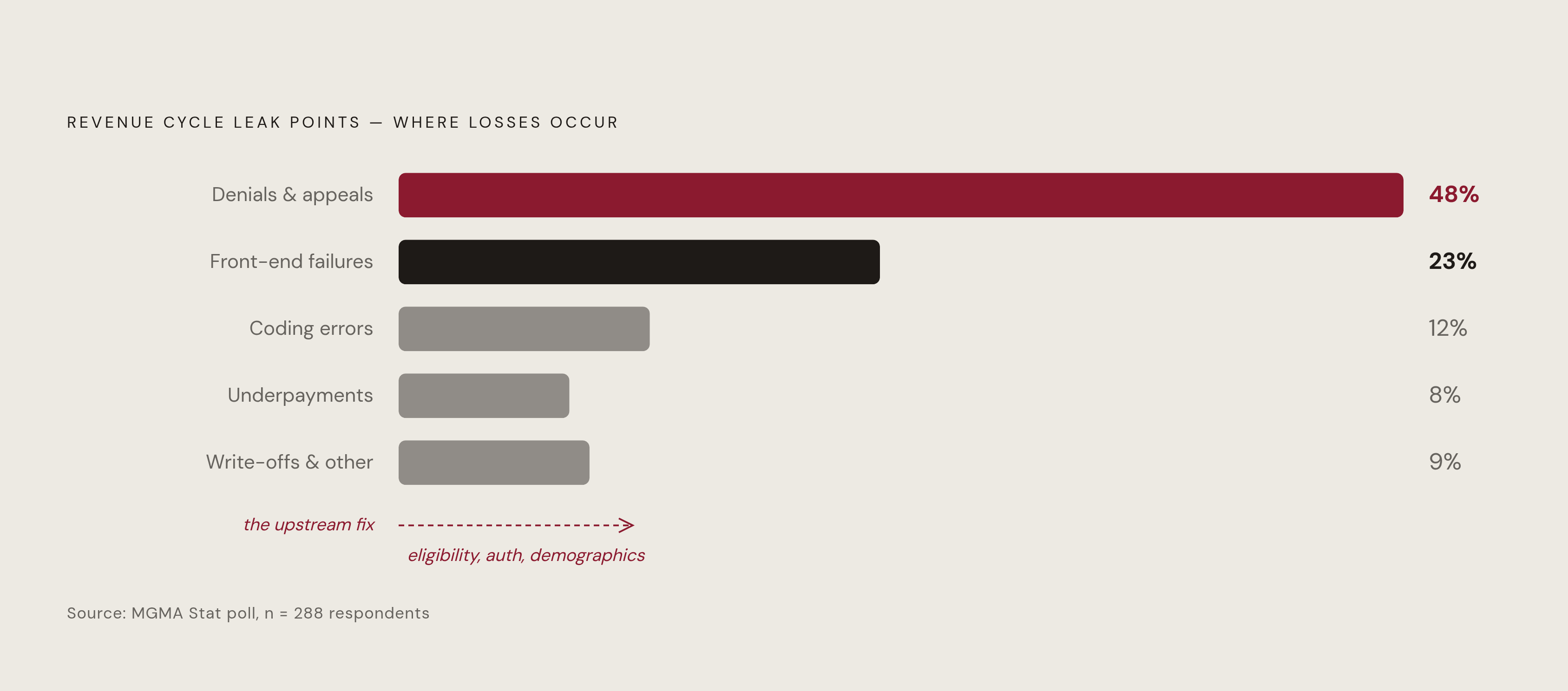
An MGMA Stat poll of 288 respondents found the two biggest revenue cycle leaks were denials and appeals at 48%, and front-end issues at 23%. Together, front-end failures and denials represent the two largest revenue cycle leak points identified in that survey. Fixing denials after the fact treats a symptom, not the cause.
A significant share of denials trace back to front-end errors: eligibility problems, demographic mismatches, missing or insufficient authorizations. Eligibility issues alone drive about 22% of preventable denials. For most specialties, front-end work means checking insurance cards and confirming addresses. For infusion, it means something far more layered: benefits verification specific to the drug, site-of-care eligibility, step-therapy documentation, and authorization tied to an exact biologic or biosimilar. All of that has to get locked down before scheduling, not before administration, and definitely not after the drug's already been given.
Across mid-market infusion organizations, elevated denial rates trace back to a short list of repeat offenders: prior authorization mismatches, drug-to-diagnosis inconsistencies, coverage lapses, missed timely filing deadlines on secondary claims. These don't happen at random. They cluster by payer, by therapy, by site of care, and a practice that can't see those clusters ends up treating every denial like a one-off exception. The same root cause keeps generating new losses month after month while nobody connects the dots.
Revenue cycle control has to start at scheduling. By the time a claim gets submitted, most of the recoverable problems are already baked in, and no amount of clean-up work downstream fixes that. Small groups need to build their intake workflows around that principle, and it's the one most generalist billing setups get wrong first. Of everything upstream, the single most consequential failure point in infusion is how prior authorization gets managed, or doesn't, across a recurring treatment cycle.
Prior authorization as a recurring lifecycle risk, not a one-time approval event
According to Practolytics, 90% of providers say prior authorization slows down patient care, 70% of PA requests need extra work before approval, and half of infusion drug PAs face at least one denial along the way. Those numbers point to something specific: PA in infusion is a recurring operational hazard that resets with every treatment cycle. It's a recurring operational hazard that resets with every treatment cycle.
Drug specificity is where this turns dangerous. An authorization for rituximab doesn't cover infliximab. Almost every infusion drug needs its own separate auth, and one of the most expensive, most common failures in the specialty happens when a physician switches a patient to a different biologic mid-cycle without triggering a fresh authorization. Most infusion medications also carry renewals tied to dosing cycles or shifts in clinical response, so a drug change, a dose adjustment, even a frequency change can each require a brand-new auth. Practices that only check authorization status at treatment initiation are exposed at every visit that follows, and most don't realize it until the denial appears in their records.
Timing adds another layer of risk. Specialty and buy-and-bill drugs often take one to three weeks for medical benefit review, and in practice, patients frequently wait even longer while orders sit in a work queue or a payer pends the request for more records. Administer before the auth clears, and the claim typically doesn't get paid, with no appeal that fixes it after the fact.
Available data shows 27% of prior authorizations get automatically or always rejected on first submission. Apply that rejection rate to even one or two high-cost drugs in a small group running a handful of treatments a week: the disruption becomes visible in the schedule this month, not next quarter.
Step therapy adds a further wrinkle, since the rules vary by state and by payer type. Some states have enacted step-therapy protections that limit how long payers can require prior-line treatment before approving biologic therapies. Any infusion group operating across state lines has to track compliance drug-by-drug and payer-by-payer. There's no single national rule to lean on, and assuming one state's playbook applies everywhere is how a group gets caught flat.
Common triggers for PA denials include missing documentation of conservative treatment tried first, step-therapy criteria requiring proof of a prior-line therapy, diagnosis-to-procedure coding mismatches, the wrong site-of-care designation, or a plain eligibility gap. Authorization failure is a primary root cause of infusion denials, and the financial damage compounds fast once the practice has already paid for a drug it can't get reimbursed for.
Buy-and-bill drug cost exposure and what a denied J-code claim costs
Under buy-and-bill, the practice buys the medication before it ever sees reimbursement. If the claim gets denied, the practice holds the full acquisition cost with nothing coming back, and the drug's already been administered. There's no walking that back once the infusion is running.
Drug costs run 60 to 80% of revenue in these settings, which makes drug spend the financial center of gravity for the whole practice. A denied J-code claim at the price points common to specialty biologics generates real exposure even when the denial rate looks small on paper. A 5% denial rate on high-cost therapies in a small group hits the bottom line directly, month after month, whether or not anyone's watching the aggregate number.
Reimbursement rules aren't uniform across payers, either. Medicare pays J-codes at ASP plus 6%, updated quarterly by CMS. Commercial payers use different formulas entirely, sometimes a percentage of AWP, sometimes tied to another benchmark price, and Medicaid varies state to state. A small group can't assume one reimbursement rule covers its entire payer mix. Treating it that way guarantees underpayments somewhere in the chain, quietly, without a denial to flag it.
CMS updates its ASP pricing files every quarter. A practice still billing off last quarter's numbers runs into reconciliation gaps that never appear as a denial. They appear as slightly less money than expected, quarter after quarter, until someone finally adds it up across a year. Infusion also carries overlapping compliance obligations: 340B program rules, Medicare Part B drug requirements, clinical trial billing rules, step-therapy law. Generalist billing teams usually aren't built to track all of that at once, and in a small group, that knowledge gap turns into a direct financial risk instead of staying an abstract compliance concern.
Payer behavior isn't making any of this easier heading into 2026. Payers are applying tighter scrutiny to infusion claims, demanding full documentation and medical necessity proof before releasing payment, and site-of-care restrictions are becoming a more common lever payers pull. Authorization failures and drug-cost exposure at least become visible as denials, something a practice can see and react to. Underpayments don't announce themselves that way. Finding them takes line-level digging.
Why underpayments hidden in remittances become permanent write-offs without active recovery
A denial is visible. It becomes visible, it gets flagged, and someone has to deal with it. An underpayment works differently: it arrives disguised as a payment. It posts, the claim closes, and it disappears into accounts receivable unless someone actively checks that line against the contracted rate and the current ASP pricing.
The quarterly ASP updates make this worse than it sounds. If a practice isn't pulling the newest CMS ASP file at the start of each quarter, every J-code claim billed during that period could get measured against stale numbers, and the underpayment goes both undetected and unchallenged. Commercial payer variation compounds it further: different methodologies and contract-specific carve-outs for biologics mean a claim can get submitted correctly and still get paid below what the contract actually specifies. Without active reconciliation against the contract rate, there's no way to know the practice got shorted, and no alarm goes off to say so.
Reimbursement compression adds pressure on top of all this. Available data indicates site-neutral payment policies are compressing reimbursement differentials by 18 to 22% on the most common infusion codes. A practice not actively tracking payer-by-payer rate trends watches its margins erode with no single trigger event to point to, just a slow bleed that becomes visible in the annual numbers and nowhere else.
In a small group, even a modest underpayment on each high-dollar treatment adds up fast across a concentrated claim set. And because those claims are already closed, getting the money back requires someone to go looking for it rather than wait for it to surface on its own. Underpayments that age past the appeal window, or that never get flagged at all, become permanent. A steady pattern of unchallenged underpayments carries the same concentration risk as one large denial. It just spreads the damage out in slow motion instead of delivering it all at once.
AR aging compounding concentration risk when high-dollar claims go unworked
Most billing operations manage accounts receivable by volume: oldest claims worked first, straight down the queue. That approach fails a small infusion group outright, where a single aged high-dollar claim can represent an entire month's worth of margin sitting untouched while a stack of small claims gets worked first simply because they're older. AR prioritization needs to run on dollar value and payer behavior, not on how long a claim has been sitting there.
Denial patterns are specific: tied to a particular payer, a particular root cause. Lump them into one generic bucket, and the signal needed to actually fix the problem disappears. A practice treating its AR as one undifferentiated queue ends up deprioritizing exactly the claims carrying the most risk, without ever meaning to.
Recovery odds fall the longer a claim sits. Payers enforce appeal windows, and timely filing deadlines on secondary claims get missed constantly when the primary denial isn't worked fast enough. This is one of the biggest AR leak points in infusion billing, and it's almost entirely a speed problem rather than a strategy problem. A denied authorization claim that misses its appeal window stops being a denial on paper. It becomes a write-off. In a small group, the dollar volume of these losses can stay low enough to never trigger a formal internal review, while still doing real financial damage month after month.
Payer behavior in 2026 isn't making any of this simpler. Coverage policies keep shifting, documentation demands keep growing more specific, and high-cost therapies keep drawing more scrutiny. A payer can quietly change policy and invalidate an appeal strategy that worked fine six months earlier, with no warning attached to the change.
Operators should be watching AR status and outcomes at a level up, not doing claim-level denial work themselves. If clinical or administrative staff are the ones spending hours untangling AR, that's a sign the RCM structure is built to absorb cost rather than recover revenue. Once the risk is traced this far back, through scheduling, authorization, drug spend, underpayments, AR, the last question is what an operation built to counteract all of it actually looks like.
What an RCM operation built for concentration risk looks like in a small infusion group
Platforms built for high-volume primary care or general medical billing were never designed around authorization lifecycles, drug-cost reconciliation, or payer-specific denial patterns, the exact things that define risk in infusion. Running one of those systems in an infusion practice is a structural mismatch, and no amount of configuration fixes that. The tool was built to solve a different problem.
Before treatment ever begins, the operation needs benefits verification and drug-specific authorization confirmed at scheduling, not at check-in. It needs auth renewal tracking tied directly to dosing cycles, not a generic calendar reminder, but a workflow that flags an expiring authorization before the appointment happens. And it needs site-of-care eligibility confirmed per payer and per drug at intake, never assumed just because the last encounter went fine.
At billing, the same discipline has to carry through. J-codes need to get billed against the current quarter's CMS ASP pricing file, not whatever number was correct three months ago. Diagnosis-to-drug alignment needs a pre-submission check, since a diagnosis-to-procedure coding mismatch is a recognized trigger for a medical necessity denial, one a simple edit would catch before the claim ever leaves the building. Documentation requirements need to get applied claim by claim, payer by payer, matching the way each payer mix actually behaves rather than a single house standard.
None of this eliminates concentration risk. The math of a small infusion group guarantees that risk stays concentrated no matter how well the operation runs. What changes is whether that risk gets caught early, worked fast, and recovered, or quietly turns into a write-off that erases a month's margin before anyone notices.