Biosimilar Substitution Financial Risk in Buy-and-Bill
Biosimilar competition is collapsing reimbursement faster than practices can adjust.
The math on buy-and-bill is simple: the spread between acquisition cost and reimbursement has to stay positive. Biosimilar competition is squeezing that spread from every direction at once, in the highest-volume infusible classes practices depend on most, including TNF inhibitors, integrin inhibitors, IL-6 blockers, neurology and immunology agents. It is what happens once real competition hits a payment system that was never built to price it. It's what happens once real competition hits a payment system that was never built to price it.
Why ASP-based reimbursement was not designed for biosimilar competition
Average sales price, or ASP, is the number Medicare uses to set reimbursement for Part B drugs. CMS calculates it and publishes it every quarter, but on a six-month lag. A drug infused in Q1 2026 gets reimbursed at the ASP CMS recorded back in Q3 2025.
That lag got built into a system designed in 2005, a full decade before the first biosimilar ever launched. Back then, ASP reimbursement only had to track slow-moving originator pricing. Nobody designed it to reimburse a molecule with three or four competing versions on the market, each one dragging the average down at a different speed.
The standard add-on is ASP+6% for most drugs, bumped to ASP+8% for qualifying biosimilars under a federal drug-pricing law, though that boost runs five years and then disappears. Because the add-on is a percentage, a reference biologic with a higher ASP throws off a bigger dollar add-on than a cheaper biosimilar does, even at the identical percentage rate. So the formula pays practices more to keep prescribing the expensive option. It's the incentive working exactly as designed, and it points the wrong way.
How fast ASP falls once biosimilar competition enters a market
Once a biosimilar enters a class, the reference product's ASP doesn't drift down. It falls off a cliff.
IQVIA data cited by the Biosimilars Council puts the average ASP decline at 8% in year one after biosimilar launch, 24% in year two, and 39% by year three. A second biosimilar entrant within three years of the first nearly doubles that pressure. Classes where biosimilars launched in 2018 or later saw a 45% ASP drop by year three, against 22% for the 2016-2017 cohort. Each wave of launches has hit harder than the one before it.
Run that math against a practice that's billed the same infused drug for years. Reimbursement can fall by close to half within three years of a biosimilar entering that class, and because of the six-month lag, nobody sees it coming. A pricing mismatch appears in the remit one day, fully formed, no warning shot fired first. Practices that treat ASP as a stable number to budget around are the ones that get blindsided, and blaming the drop on a bad quarter instead of a structural trend is the mistake that keeps repeating.
How rebate structures push biosimilar ASP below acquisition cost and strand the practice in between
Biosimilar manufacturers compete hard for formulary position, and the currency of that fight is rebates paid to insurers, not price cuts to practices. Win fail-first or preferred status, and the rebate gets folded into the reported sales price used to calculate ASP. That pulls ASP down, sometimes sharply. It does not pull the practice's acquisition cost down at the same rate, because the practice never touches the rebate. It pays list or contract price and gets reimbursed against a number a manufacturer's rebate deal already hollowed out.
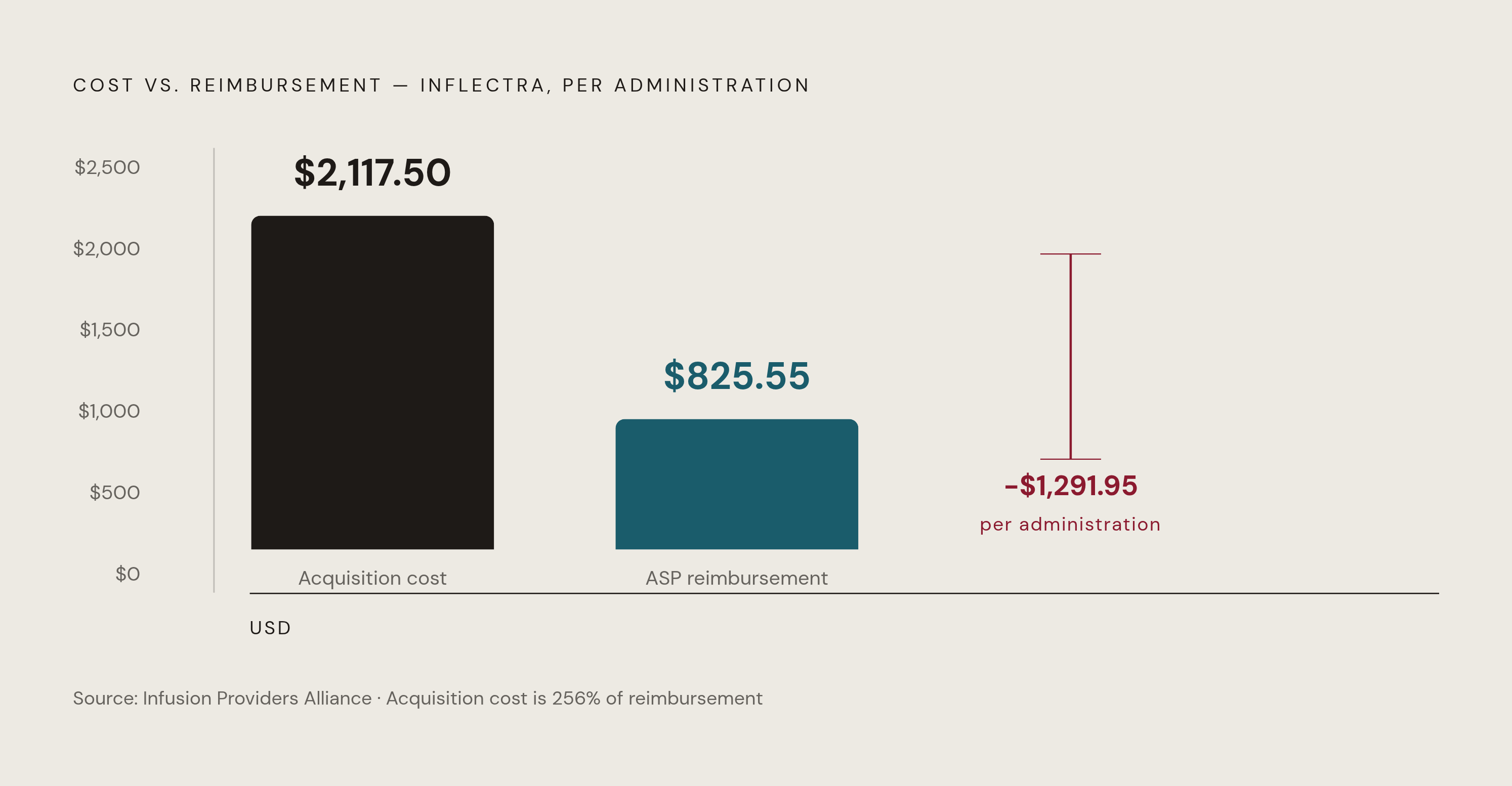
The Infusion Providers Alliance put a number on how ugly this gets. One member acquires Inflectra (infliximab-dyyb) at $2,117.50 for a typical patient administration. ASP reimbursement comes back at $825.55. That's a loss of $1,291.95 on a single administration, with acquisition cost running 256% of what the payer sends back. Commercial payers reimburse on the same ASP paradigm, so an independently owned practice sees the identical squeeze whether the patient walks in with Medicare or a commercial card.
What the IRA's biosimilar add-on payment change fixes and what it leaves unresolved
Starting October 1, 2022, Medicare raised the biosimilar add-on from ASP+6% to ASP+8% of the reference product's ASP, for any biosimilar priced below its reference product. The goal was straightforward: give practices a real financial reason to reach for the biosimilar instead of defaulting to the brand.
The flaw sits in the mechanics. The 8% gets calculated against the reference product's ASP, which is higher than the biosimilar's own compressed ASP, so the boost sounds generous on paper and rarely touches the actual gap. Go back to the Inflectra numbers: an 8% uplift on an already-crushed ASP does nothing to close a shortfall where acquisition cost runs two and a half times reimbursement. The arithmetic doesn't get there, and it was never going to.
The enhancement also expires. Five years, then it's gone, with no legislative guarantee of what replaces it. If the market for a given biosimilar hasn't stabilized by the time that window closes, practices absorb renewed compression right when they'd started planning around the higher add-on.
Payer-mandated substitution and interchangeability-driven risk that practices cannot fully control
FDA interchangeability is a regulatory designation, earned molecule by molecule through its own approval pathway. Payer substitution policy is a different animal entirely, and increasingly, payers aren't waiting for the FDA's blessing before pushing patients toward the cheaper biosimilar.
Step therapy is the tool of choice. A growing number of payers now require a patient to try the biosimilar first, fail on it, or simply default to it, regardless of what the prescribing physician ordered. The decision that used to sit with the doctor and the practice increasingly sits with the formulary instead.
CareFirst BlueCross BlueShield began requiring prior authorization and site-of-care management for additional medications starting July 1, 2025, and that's the direction the whole payer landscape is moving. A handful of vertically integrated insurer-PBM combinations manage the majority of covered lives in the country. That concentration is why the shift is accelerating: it hands a small number of players outsized leverage over formularies, rebate flows, and which channel a drug moves through.
Site-of-care steering as a third layer of financial pressure on top of ASP risk
Drug margin isn't the only thing under attack. Where the infusion happens is under attack too.
As infused drug volume climbs, payers keep pushing administration out of hospital outpatient departments into ambulatory settings, and out of office-based infusion suites into patients' homes. Cheaper site, cheaper claim, from the payer's side of the ledger.
Home infusion runs on a completely different billing architecture: separate supply codes, separate nursing codes, pump billing, its own drug reimbursement structure. A practice redirected into home administration without RCM built for that channel takes on compliance exposure on top of the lost revenue.
Site-neutral payment policy strips out the facility fee advantage that used to make hospital outpatient departments attractive, and that hits hospital-based settings hardest. The two pressures compound from there: a payer can mandate the lower-ASP biosimilar and redirect site of care in the same policy move. Drug-margin loss and volume loss land on the practice at the same moment, from the same decision.
Claims-level metrics practices need to track to catch substitution-related losses before they become permanent
The six-month ASP lag causes a pricing mismatch that usually appears first in the remit. Line-level remittance reconciliation is the earliest warning a practice gets that something's gone wrong.
J-code accuracy isn't optional. Bill the reference product's J-code when a biosimilar was actually administered, and that claim is exposed to denial, especially now that payers run NLP and adjudication algorithms built specifically to cross-check the billed code against the clinical note.
The sneakier failure is the claim that gets paid, just not enough. A biosimilar claim can come back with partial payment that quietly sits below acquisition cost without tripping any denial alarm. Without someone reconciling at the line-item level, that gap turns into a permanent write-off nobody ever catches. Denial rates overall climbed from 30% in 2022 to 38% in 2024, and infusion-specific J-code errors and step-therapy denials represent a category a practice can actually do something about.
Prior authorization management as a frontline defense against substitution-triggered denials
Payer-driven substitution tends to hit first at the authorization stage, before a single claim gets filed. A PA written for reference infliximab may not cover infliximab-dyyb (Inflectra) automatically. Worse, a payer might approve a biosimilar that isn't even the one sitting in the practice's own inventory.
Timing turns this into a patient-care problem, not just a billing one. Infusion runs on recurring schedules, so a lapsed authorization or a product mismatch mid-cycle can delay treatment for a patient already partway through it. The denial that follows lands retroactively, after the damage to both the schedule and the revenue is already done.
Getting ahead of it means starting the prior auth process before a formulary change takes effect, not scrambling after the payer has already swapped the preferred product on the claim. And when a payer requires fail-first on the biosimilar before allowing the reference product, the clinical documentation trail needs to be airtight. Incomplete records around that trial-and-escalation history are a significant denial trigger in infusion billing.
A purpose-built infusion RCM operation in a biosimilar substitution environment
Every risk covered here, the ASP lag mismatch, the rebate-driven underpayment, the payer substitution mandate, the step-therapy documentation burden, the site-of-care redirect, is specific to infusion. None of it is generic revenue cycle work, and treating it as generic is how practices lose the margin.
A general-purpose RCM platform built for the broad universe of medical claims has no reason to track drug-code-level ASP shifts on a quarterly cycle, flag a biosimilar substitution the moment a payer changes its formulary, or reconcile a partial payment against a known acquisition cost before it hardens into a write-off. Infusion margin lives and dies in details that specific. Holding onto it takes RCM infrastructure built around those specifics from the start, not adapted to them after the fact, especially with the biosimilar pipeline set to keep expanding through 2026 and beyond.
Sources
- biosimilarscouncil.org
- infusionprovidersalliance.org
- advisory.avalerehealth.com
- ajmc.com
- ajmc.com
- Biosimilar Reimbursement Models: The Definitive Analyst’s Guide to Buy-and-Bill, PBM Dynamics, ASP Mechanics, and the Structural Forces Shaping Biologic Market Access - DrugPatentWatch – Transform Data into Market Domination
- centerforbiosimilars.com
- managedhealthcareexecutive.com