Drug Waste Billing Compliance in Infusion Reimbursement
Misclassifying vials costs practices through denials with no recovery path.
What the single-dose vs. multi-dose vial distinction controls
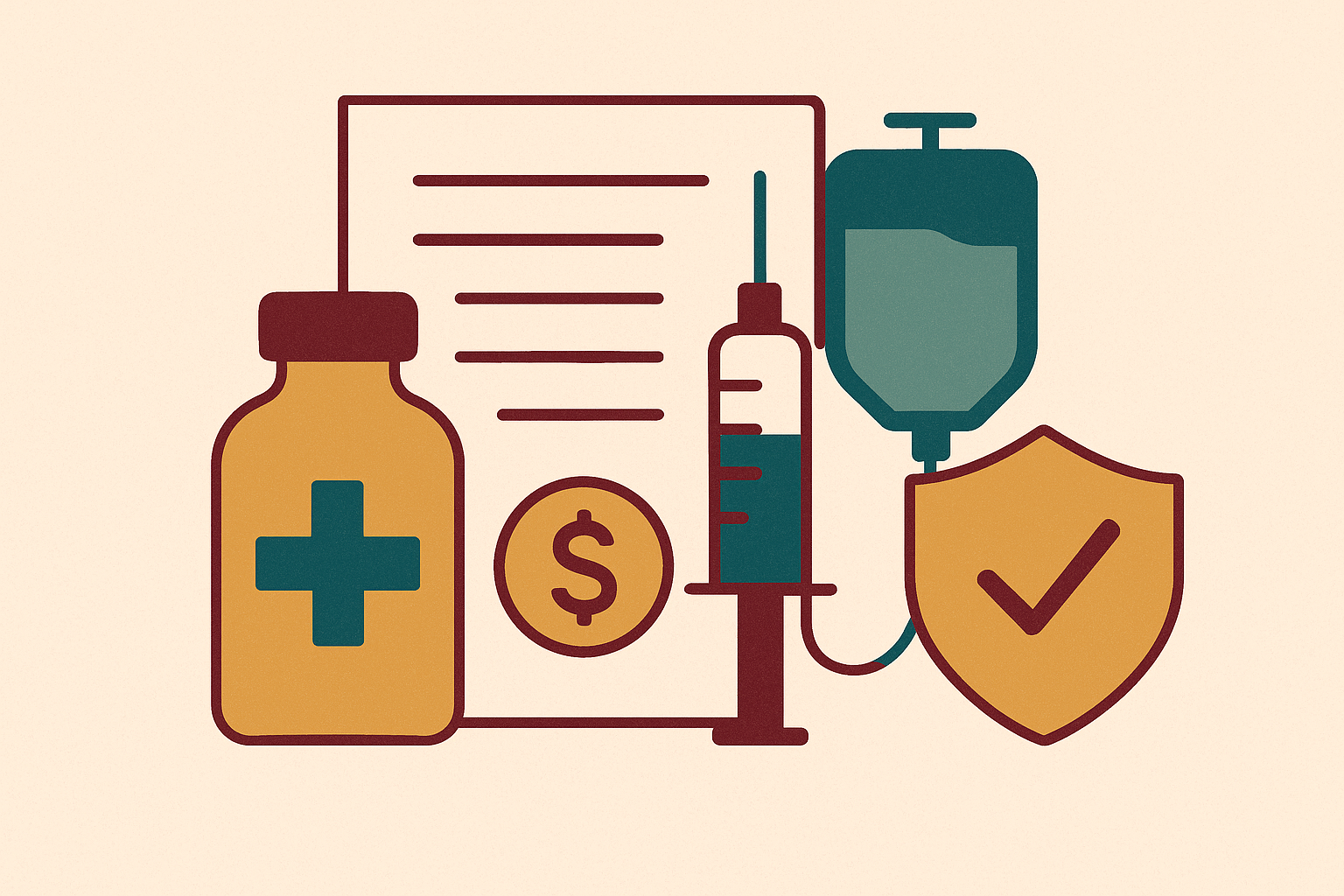
Everything downstream in an infusion claim depends on getting one classification right at the very start: is this drug packaged in a single-dose vial or a multi-dose vial?
Get that wrong and every layer built on top of it fails too.
JW and JZ modifiers apply only to single-dose, single-use containers. Multi-dose vials never take a JW or JZ modifier, and waste from a multi-dose vial is never billable. No exceptions. That single sentence trips up more practices than it should, and it's an expensive place to be careless, because the fix isn't a resubmission, it's a denial with no path to recovery.
Single-dose vials are built to hold exactly one dose. Whatever's left after the patient's infusion has to be discarded, and that leftover amount becomes billable waste, governed by the modifier rules covered next. Knowing which category a drug falls into is a pharmacy and charge description master (CDM) question, tracked at the individual NDC level. Practices need that classification settled before a single claim goes out, not figured out after a denial comes back asking why.
How the JW and JZ modifiers work
JW reports the amount of drug thrown away. It sits on its own claim line, using the same HCPCS code and date of service as the line reporting the administered dose, but the units on that JW line represent only the discarded portion, nothing else.
JZ works differently. It's an attestation: a formal statement that nothing was discarded from the single-dose container. JZ sits on the administered-dose line itself and doesn't change the payment amount. Its only job is to confirm zero waste happened.
The two can't share a claim. Either something was wasted, and JW carries its own waste line, or nothing was wasted, and JZ goes on the administered line. Report both on the same drug, same date, and the claim fails payer edits before a human ever reviews it.
Medicare does pay for documented waste, up to the labeled amount on the vial, and the administered dose line and the JW waste line both get reimbursed at the same ASP-based rate. When the paperwork holds up, that's real revenue, not a rounding error. Skipping the documentation turns the JW waste line into revenue the practice earned but will never see.
The Discarded Drug Refund Program and federal scrutiny of JW/JZ data
Section 90004 of the Infrastructure Investment and Jobs Act created the Discarded Drug Refund Program, and it changed what JW and JZ data means to CMS. Starting with 2023 data, manufacturers have to refund CMS when discarded amounts of a refundable single-dose drug exceed 10% of that drug's total allowed charges.
Those refund calculations run entirely on provider-submitted JW and JZ data. Modifier accuracy at the practice level is now a direct input into a federal manufacturer accountability program.
Overreporting waste doesn't just risk an internal audit anymore. Inflated JW units overstate what a manufacturer owes CMS, and that turns a documentation shortcut into a federal compliance problem. Underreporting carries a quieter cost: forfeited reimbursement the practice actually earned. Neither error is the safe one. The only defensible position is documentation that's contemporaneous and consistent every time: dose ordered, dose given, amount discarded, reason for the waste.
Where documentation breaks down: the clinical record elements that make JW defensible
A JW line holds up only when the clinical note includes three things: administered dose, discarded amount, and vial size. All three, not two out of three. Dropping any one of the three elements causes the waste calculation to lose its support.
Documentation failures cluster in predictable spots. The note confirms the drug was given but skips the exact volume administered, so there's no way to back into what was discarded. Vial size never makes it into the medication administration record, breaking the arithmetic that's supposed to tie administered plus discarded back to the labeled amount. Waste gets logged informally, something like "some left over," instead of quantified in actual billing units. Start and stop times go missing too, which matters for time-based administration coding on its own, but also tends to travel with generally thin drug administration records, and start/stop documentation is one of the most common audit targets in the business.
Dispensed amount is a critical data element for this exact reason. When what the pharmacy actually dispenses differs from how the billing unit gets defined, somebody has to reconcile that gap before the claim goes out. Not after the denial comes back.
Payers have stopped relying on manual chart review to catch these gaps. Natural language processing and claims adjudication algorithms now check billed codes against the clinical notes sitting behind them. A JW line on a thin note used to be an audit risk. Now it's a machine-detectable one, flagged before anyone in billing even sees the rejection.
NDC reporting requirements and claim mismatches
A perfectly documented waste claim can still die on formatting alone. The NDC has to appear in the correct format on the CMS-1500 form or its electronic 837P equivalent. Get that format wrong and the claim rejects, regardless of how clean the JW or JZ modifier is.
The unit of measure tied to the NDC matters just as much: milliliter, unit, gram, international unit, whatever fits that specific drug. Submit the wrong UOM and the billed quantity fails payer validation before anyone even gets to medical necessity.
What counts as a "minor" NDC discrepancy is broader than most billing teams assume. A transposed digit. An NDC that went stale after a manufacturer repackaged the product. A mismatch between the NDC sitting in the CDM and the one actually printed on the vial the nurse pulled that day. None of these have anything to do with whether the clinical documentation was solid, and all of them can delay or shrink a payment anyway.
NDC data isn't a set-it-once field. The Forvis Mazars 2025 framework lists NDC information as a pharmacy CDM element requiring ongoing maintenance, which is a formal way of saying somebody has to keep checking it, on a recurring schedule, indefinitely.
ASP accuracy and drug waste exposure
Most physician-administered Part B drugs get reimbursed at ASP plus 6%, and CMS recalculates that ASP figure every quarter. In a buy-and-bill practice, any downward adjustment to that rate immediately squeezes the gap between what the drug cost to acquire and what the payer sends back.
The waste line rides the same rate as the administered dose line. So when the ASP figure is wrong, or a practice applies last quarter's rate instead of the current one, two failures happen at once: the practice gets underpaid, and the waste reporting attached to that rate becomes suspect on top of it.
CMS kept refining how it collects, audits, and adjusts ASP data into 2026, and a discrepancy anywhere in that chain can produce delayed claims or retrospective adjustments months later. A retrospective ASP correction can turn a claim that was billed correctly at the time into an overpayment finding, with no new error on the practice's part.
That's why waste recovery isn't a side benefit layered on top of the core business, it's often the business. For some drug-payer combinations, the spread between acquisition cost and reimbursement is already thin enough that a single encounter can run underwater before waste even enters the math. For certain drugs and certain payers, accurate waste recovery is the entire difference between a net-positive encounter and a net-negative one.
How payer behavior and audit activity amplify the cost of errors
None of this plays out in a static environment. Claim denial rates reached roughly 12% in 2025, and net revenue leakage tied to denials grew 25% year-over-year. A chunk of that growth traces directly to payers using AI to generate automated denials faster than billing staff can respond to them.
Oncology took an outsized hit. The 2026 Medicare Advantage Denial Report put oncology's denial rate at 12.7%, among the highest specialty rates measured. That denial pressure falls squarely on the drug and infusion claim categories where JW/JZ accuracy lives.
High-dollar oncology and infusion claims draw more manual review now too, as payer AI flags "risk" patterns and routes claims for a closer look, a process that can add two to six weeks to payment timelines. For a practice that already fronted the drug cost under buy-and-bill, those weeks aren't abstract. That's real cash sitting unrecovered on the practice's balance sheet while the clock runs.
The same NLP tools scanning clinical notes for JW support are getting folded into general claims adjudication. A JW line without a note behind it gets flagged the moment it's submitted, before a person ever touches the claim.
The operational
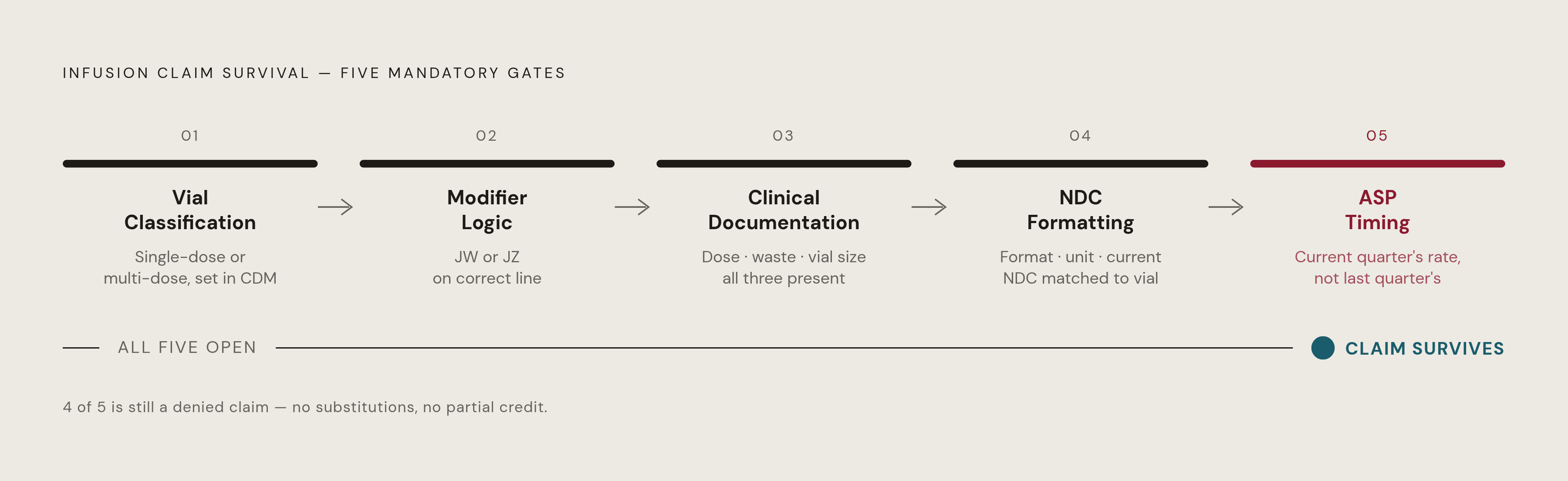
Vial classification, modifier logic, clinical documentation, NDC formatting, ASP timing: every layer here has to hold at once for a claim to survive. None of them is optional, and none of them substitutes for the others. A practice that nails four out of five still loses the claim.
The practices staying ahead of this treat it as one connected system, not five separate compliance tasks. Vial classification gets built into the CDM before a drug is ever ordered. Documentation templates force the three required data points, administered dose, discarded amount, vial size, at the point of charting, not reconstructed later from memory. NDC data gets reviewed on a set schedule. ASP updates get tracked quarterly, on the day CMS publishes them, not whenever someone happens to notice the reimbursement looks light.
The Discarded Drug Refund Program raised the stakes on what modifier accuracy actually means. JW and JZ now feed a federal manufacturer refund calculation, and the scrutiny on that data is still climbing, not leveling off. Getting all four layers right, every time, stopped being a compliance nicety a while back. For an infusion practice carrying real acquisition cost on high-priced biologics, it's the mechanism that decides whether the encounter clears a margin or eats one.