State-Level 340B Payer Access Laws and Infusion Reimbursement
State laws protecting 340B drug discounts face uneven legal enforceability across jurisdictions.
State-level 340B payer access laws have created a reimbursement environment that changes depending on which state an infusion practice operates in. The spread that makes many infusion programs financially viable now depends on laws whose enforceability varies by jurisdiction. That spread is under pressure from manufacturers, payers, and now a proposed federal rule.
How the 340B program creates a reimbursement spread that infusion practices depend on
The financial engine behind 340B for infusion providers is the gap between what a covered entity pays to acquire a drug and what a payer reimburses for it. A covered entity buys an outpatient drug at a steep 340B discount, then bills commercial payers and Medicare at standard rates. For infused and injected biologics, which carry high per-unit costs, that gap can be substantial.
Buy-and-bill concentrates this effect. The infusion provider purchases the drug directly, administers it, and bills for both the drug and the administration service. Under that model, the 340B margin is not a side benefit. It is a structural pillar of infusion center economics. Contract pharmacies extend the program's reach for covered entities that do not operate an in-house pharmacy. Without contract pharmacies, community health centers and many infusion-adjacent safety-net providers have no other way to get 340B pricing.
NACHC's 2025 legislative review identifies manufacturer actions, including PBM discriminatory contracting and contract pharmacy restrictions, as diverting savings away from patient care at covered entities. The threat to the spread is not theoretical. It is already moving through the system.
Why drugmakers began restricting contract pharmacy access and what that did to infusion revenue
Starting in 2020, drugmakers began imposing unilateral restrictions on which contract pharmacies could receive 340B-priced drugs. If a covered entity did not submit the data manufacturers required, it lost access to 340B pricing on affected products. For an infusion program using those drugs, that is a direct revenue threat.
Lilly escalated the pressure in February 2026 by expanding its claims-data requirement to include in-house pharmacy dispensing. By June 2026, if a hospital did not comply, it had five business days to submit data or lose access to 340B pricing. The American Hospital Association called the policy unlawful and warned it would increase costs and administrative burdens for hospitals serving vulnerable populations. At least six other drugmakers announced similar policies for in-house claims data.
The compliance infrastructure now required did not exist as an operational necessity a few years ago. Platforms like 340B ESP handle claims submission. Kalderos, now owned by Model N, and IntegriChain cover duplicate-discount and channel-reconciliation work. Infusion programs now face new administrative overhead just to keep pricing they once received automatically.
Arkansas was the first state to push back. In 2021, it prohibited manufacturers from restricting access to 340B-discounted drugs at contract pharmacies. That law became the template other states would follow.
The state legislative response: 37 laws enacted, 21 with contract pharmacy provisions, and a fragmented map
States have responded with a large and growing body of legislation. But the resulting patchwork differs in scope, covered entities, and enforcement. That creates a compliance and reimbursement environment that varies materially by state.
By April 15, 2026, NACHC's tracker shows 37 states with laws to protect 340B savings. Of those, 21 have passed contract-pharmacy-specific provisions. The list includes Arkansas, Colorado, Hawaii, Louisiana, Maine, Maryland, Minnesota, Mississippi, Missouri, Nebraska, New Mexico, North Dakota, Oklahoma, Oregon, Rhode Island, South Dakota, Tennessee, Utah, Vermont, Washington, and West Virginia.
The substantive differences among these laws are what create operational complexity. Arizona SB 1176 prohibits third parties from discriminating in reimbursement, assessing fees or adjustments, excluding pharmacies from networks, or restricting how 340B drugs may be dispensed, when the basis is that the pharmacy dispenses a 340B drug. Arkansas HB 1881 prohibits discriminatory contracting, including differences in reimbursement, refusal to allow 340B pharmacies into networks, requirements to identify 340B drugs with a modifier, and practices that transfer the benefit of 340B savings away from providers.
California SB 786 takes a different angle. It prohibits PBMs from discriminating against covered entities, refusing to contract, excluding them from networks, retaliating against them for exercising rights under the law, or interfering with patient choice. Connecticut HB 6669, effective January 1, 2024, prohibits PBM contracts from containing reimbursement rates below those paid to non-340B pharmacies, fees not imposed on non-340B providers, or exclusions based on 340B participation.
Scope limitations matter just as much as the protections themselves. New Mexico's protections apply only to community health centers, not all covered entities. An infusion provider's protection depends on facility type. Tennessee's law applies only to drugmaker restrictions placed after July 2025, a temporal carve-out that leaves prior restrictions in place. Colorado also pairs payer protections with new reporting requirements, and it restricts use of 340B savings on advertising, lobbying, food, and board member travel.
The reporting wave is expanding. Seven states passed provider reporting requirement laws in 2025. States with mandatory reporting for community health centers include Idaho, Minnesota, Ohio, Washington, and Rhode Island. Ohio published detailed individual 340B covered entity reports based on its 2025 law, which shows early on that these requirements have teeth. Pennsylvania introduced bipartisan 340B contract pharmacy and PBM bills in October 2026. The legislative wave has not crested.
Litigation outcomes determine whether a state law actually changes payer behavior — and the results are split
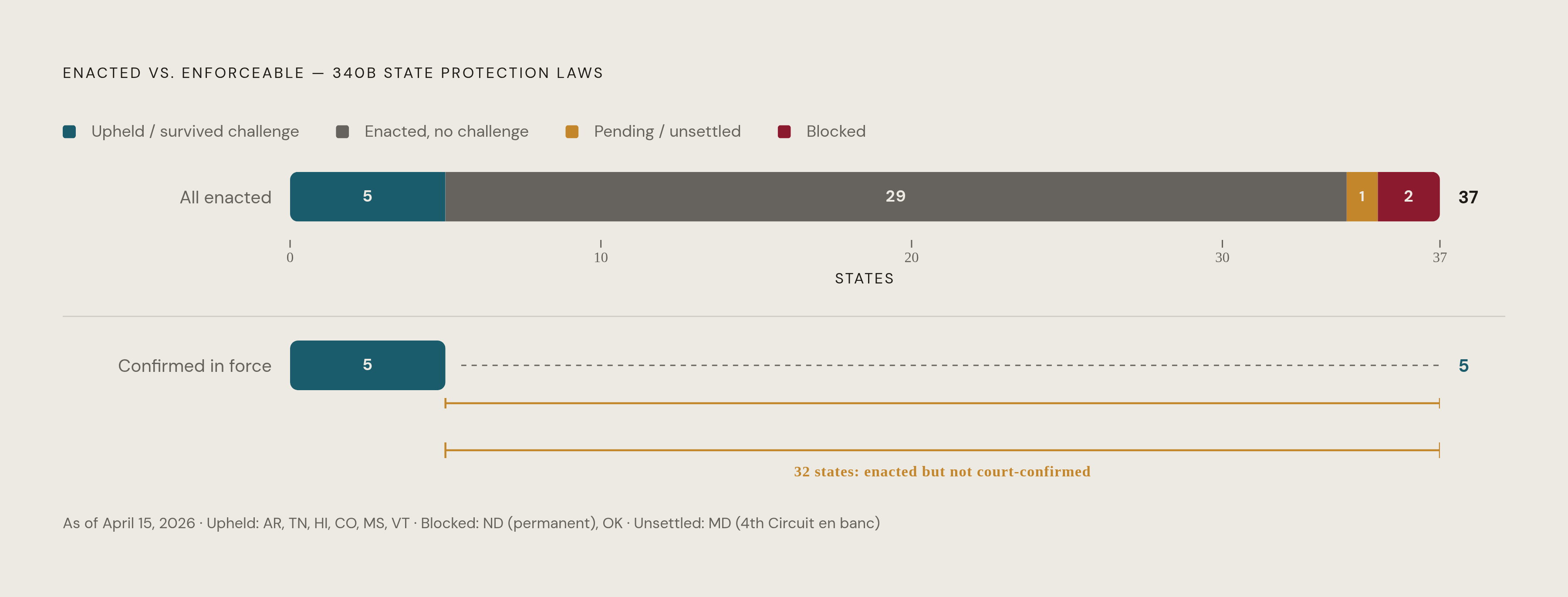
A state law on the books does not mean a state law in force. A 340B protection gives you no operational certainty until it survives a legal challenge. The current litigation landscape shows a genuine split.
Arkansas Act 1103 is the most legally tested state law to date. The Eighth Circuit upheld it, the Supreme Court denied certiorari on December 9, 2024, and a federal judge upheld the law against AstraZeneca's suit as recently as September 29, 2026. Infusion programs in Arkansas can plan around that durability.
Several other states have withstood early challenges. Drugmakers sought preliminary injunctions against the Tennessee and Hawaii laws, but courts denied them, so the laws remain in force. Colorado's law survived an AbbVie challenge. A federal judge rejected AstraZeneca's challenge to Mississippi's law. In October 2026 a federal district judge said PhRMA could not block Vermont's revised 340B law.
Other laws have not fared as well. A federal judge permanently blocked North Dakota's 340B law. Oklahoma's law was blocked one day before it took effect. Maryland's law faced a Fourth Circuit panel that sided with drugmakers, though the full Fourth Circuit later granted en banc rehearing, leaving the outcome unsettled.
Newly enacted laws face immediate challenge. AbbVie, Novartis, and Bristol Myers Squibb separately sued to block Illinois' contract pharmacy access and claims data protection law shortly after the governor signed it. Litigation updates in Oregon, Hawaii, Washington, Colorado, and Mississippi were still being reported as of October 8, 2026.
For infusion operators, the lesson is straightforward. A state's enactment of a 340B access law does not mean the law governs payer and manufacturer behavior on day one. Legal status must be monitored state by state, and billing strategy should account for enforceability, not just existence.
The federal reimbursement threat running counter to state access laws
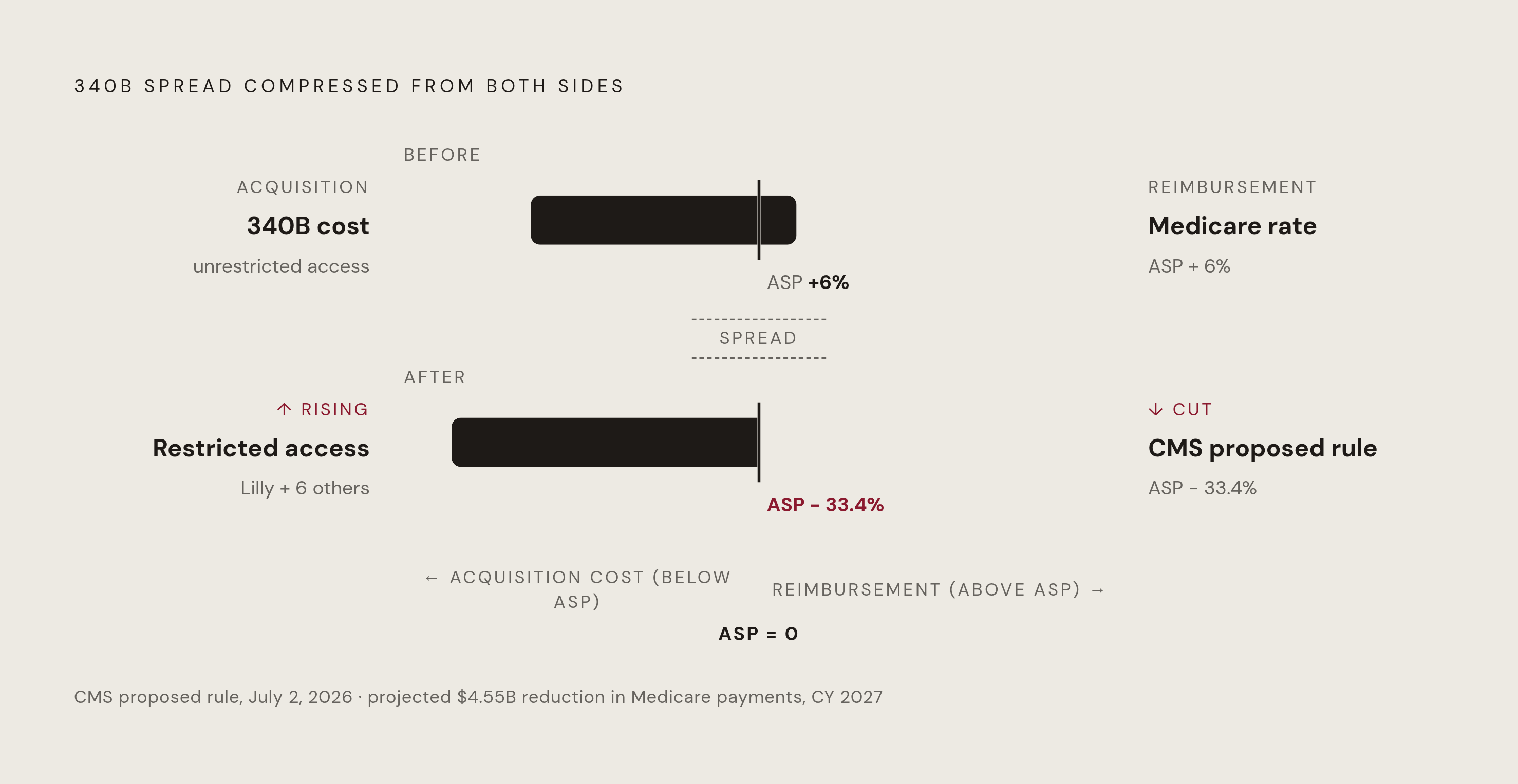
States are working to protect access to 340B pricing on the commercial side, but on July 2, 2026 CMS released a proposed rule that would sharply reduce Medicare reimbursement for 340B-acquired drugs. The spread is being compressed from the federal payer direction at the same moment states are trying to protect it from manufacturers. The proposed rule would replace the current Medicare payment methodology for most 340B-acquired drugs with an acquisition cost-based approach. CMS would pay for 340B-acquired drugs at ASP minus 33.4 percent, while non-340B drugs would still be paid at ASP plus 6 percent. CMS projects this would reduce Medicare payments for 340B-acquired drugs by about $4.55 billion and cut beneficiary cost-sharing by about $1.15 billion during calendar year 2027.
Children's hospitals, prospective payment system-exempt cancer hospitals, and rural sole community hospitals would be exempt from the proposed change. For everyone else, the effect on infusion economics would be direct. Hospital outpatient departments and covered-entity infusion programs that rely on 340B-acquired oncology and specialty biologics would see their Medicare reimbursement margin compressed substantially. In some cases, the financial case for buy-and-bill at the facility would disappear.
This is the policy inversion. State laws enacted to protect 340B savings from manufacturer restriction would leave covered entities with access to discounted drug prices. The CMS rule would simultaneously reduce what Medicare pays for those drugs, neutralizing much of the preserved spread on the federal payer side.
The rule is proposed, not final. If finalized, the new payment rate would take effect for calendar year 2027. Infusion programs should model that revenue impact now, not after finalization.
How payer obligations under state laws interact with commercial reimbursement for infused drugs
State 340B access laws impose specific obligations on commercial payers and PBMs. Where those laws are enforceable, they directly affect how infusion claims are priced, adjudicated, and paid. The obligations differ so much by state that you need jurisdiction-specific billing and contracting strategy.
The core prohibitions are consistent across multiple states. Payers cannot pay 340B pharmacies less than non-340B pharmacies for the same drug in Connecticut, Colorado, Arizona, and Arkansas. Arizona and Arkansas prohibit fees, chargebacks, clawbacks, or adjustments imposed solely because a drug is a 340B drug. California, Connecticut, Colorado, and Arkansas prohibit excluding 340B pharmacies from networks on the basis of 340B participation. Arkansas prohibits requiring a modifier that identifies a claim as a 340B drug, a rule directly relevant to infusion J-code billing where modifier use is common. Connecticut prohibits interfering with patient choice to receive a drug from a covered entity or its contract pharmacy, including by administration. Where these prohibitions hold up in court, infusion centers in those states can challenge payer practices that reduce payment on 340B-acquired drug claims. Denial management and underpayment identification become more actionable.
The pattern to watch is the one alleged in the CVS and Mount Sinai lawsuit. The allegations describe CVS processing claims initially at standard rates, then reducing them later when the claims were identified as 340B-eligible. That is exactly the kind of payer conduct these nondiscrimination laws are designed to prohibit. Infusion operators should recognize that pattern in remittance review.
Multi-state infusion groups face the hardest challenge. Payer contracts may be national or regional, but what they must satisfy legally differs by state. A contract acceptable in a state without a 340B nondiscrimination law may be legally deficient in a state that has one.
What the fragmented landscape means for infusion billing operations in practice
Because state law, manufacturer claims-data requirements, payer adjudication, and federal reimbursement pressure all vary, you cannot run infusion billing on a single national protocol. The math is genuinely different depending on jurisdiction, payer, and drug. Prior authorization is compounded by 340B status. Before a patient receives a specialty biologic infusion, the practice must confirm prior auth for the drug and administration service, whether the payer recognizes the site of care as a covered entity, and what acquisition model the payer requires. Those answers are now jurisdiction-dependent.
J-code billing has a modifier problem. Arkansas and other states prohibit payers from requiring a modifier that identifies a drug as 340B. Practices billing in states without such a prohibition may face payer modifier requirements that affect adjudication. J-code billing protocols must be state-aware.
Underpayment identification is now a 340B-specific risk. Where payers reduce reimbursement on claims identified as 340B-eligible, aggregate-level remittance review will not catch it. Line-level reconciliation that compares expected reimbursement against actual payment by drug, J-code, and payer is necessary.
If your revenue cycle operations begin at claim submission, you are already too late. By the time a 340B-acquired drug claim is submitted, the practice either has or has not confirmed the payer's adjudication rules, the applicable state law, and the drug's authorization status. Recoverable problems are seeded at scheduling and benefits verification. The judgment calls around 340B-related payer conduct, J-code accuracy, and jurisdiction-specific denial patterns cannot be handled by a rules engine alone. You need an infusion-specialized revenue cycle model with software and hands-on operators who know infusion payer behavior, because each claim carries context a scripted workflow cannot see.
What infusion practices should monitor as the 340B legal and policy environment continues to shift
The 340B environment is not moving toward stability. The legislative, litigation, and federal policy fronts are all active at once. The practices best positioned to protect revenue are those treating 340B legal status as an ongoing operational input rather than a one-time compliance check.
On the legislative front, Washington and Connecticut advanced bills in 2026. Minnesota advanced a bill through the Senate that failed in the House. Pennsylvania introduced bipartisan 340B bills in October 2026. New laws will continue to alter the commercial payer obligation map.
On the litigation front, outcomes in Oregon, Hawaii, Washington, Colorado, and Mississippi remain in motion as of October 2026. Laws can be enacted and then blocked, or blocked and then reversed on appeal. The enforceability of state protections is a live question, not a settled one.
Manufacturer claims-data requirements will spread. Lilly's enforcement of its in-house pharmacy claims-data requirement, effective February 2026, signals that other manufacturers will follow. Practices without compliant data-submission workflows risk losing 340B pricing on key infused biologics, which eliminates the spread entirely.
The CMS proposed rule is the largest single variable. If finalized, the ASP minus 33.4 percent rate for 340B-acquired drugs starts in calendar year 2027. Infusion programs should model that scenario now.
Reporting requirements add a new compliance layer. States including Ohio, Idaho, Indiana, Rhode Island, and Hawaii have enacted CHC reporting requirements. Colorado, Maine, and Vermont require hospital-specific reporting. As implementation matures, the administrative burden on covered-entity infusion programs will grow. The practices most exposed are those running revenue cycle operations that do not track reimbursement outcomes by payer, drug, and state. The signal that a state law is being violated or a federal rule change is hitting revenue only appears in line-level data reviewed by operators who know what to look for.