340B Drug Acquisition Cost vs Buy-and-Bill Spread Economics
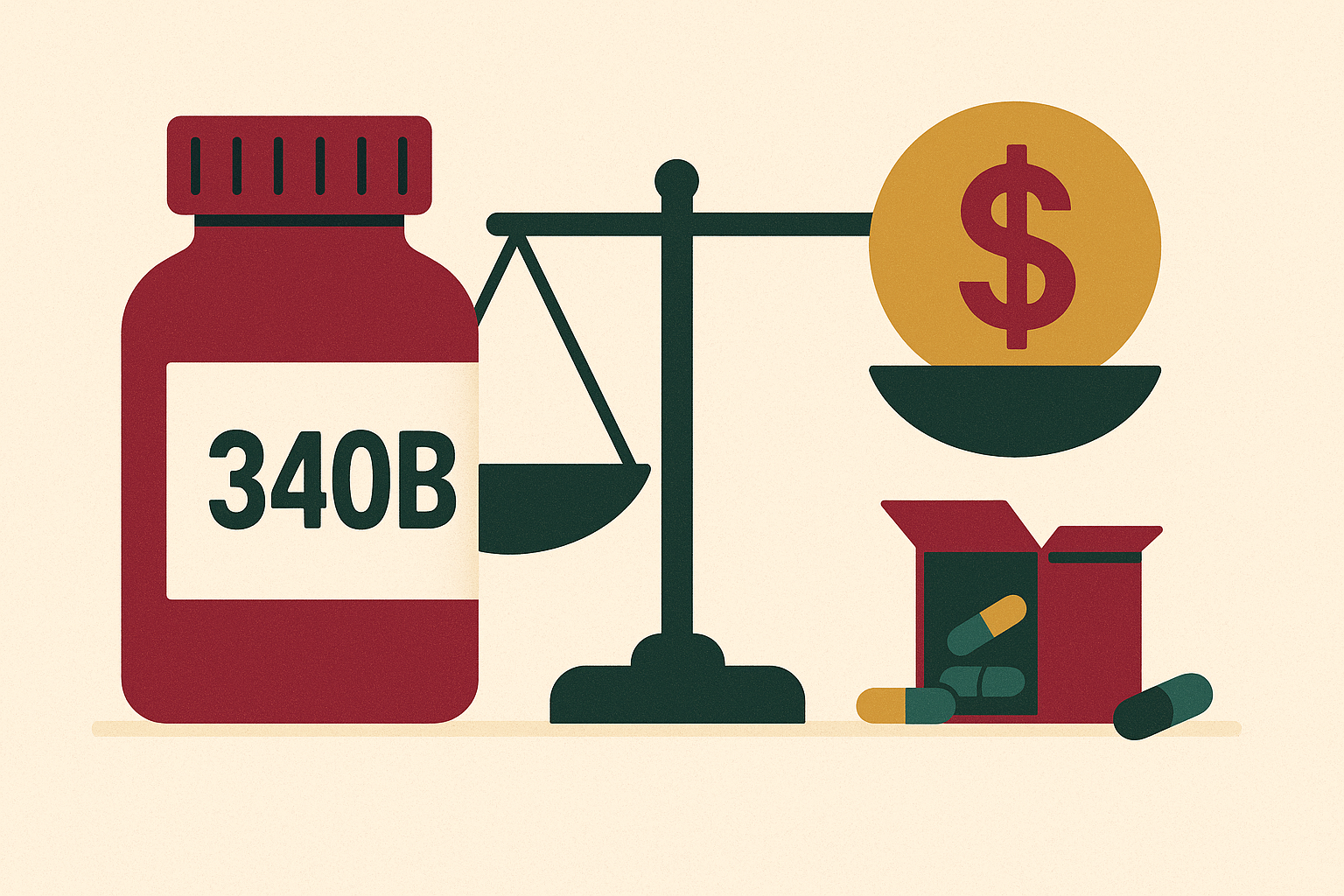
Both 340B and buy-and-bill make money off the same basic gap: what a drug costs to buy versus what a payer pays back for it. But they get there by two different roads, and mixing up which road a practice is on is a common and costly mistake.
Under the 340B program, hospitals and other covered entities buy outpatient drugs at a discount, anywhere from 25% to 50% off average wholesale price. Eligibility runs through the institution, not the prescription. Once a hospital is in, the discount applies at the moment of purchase, before anyone knows which patient the drug will go to.
Buy-and-bill runs on a tighter, riskier version of the same idea. A practice buys the drug at wholesale cost, with no federal discount attached, gives it to the patient, and then bills the payer at whatever rate their contract sets. The margin is what the practice collects back minus what it paid. There's no discount cushion sitting underneath it. And because the practice pays for the drug before it ever sees reimbursement, every single claim is its own small bet, one the practice has already put money down on.
The split that matters here: 340B spread is a bulk discount, locked in in advance, captured at the institutional level. Buy-and-bill spread is earned one claim at a time, and how well the billing gets executed determines how much of it the practice keeps. Those are different kinds of economics, not just different sizes of the same thing, and that's why a revenue cycle built around one rarely holds up when applied to the other.
Why 340B spread concentrates in specialty and infusion drugs
Specialty and infusion drugs sit at the center of this whole comparison because they carry the highest list prices in medicine, and high list prices turn a thin percentage spread into a large dollar figure. This is where 340B and buy-and-bill economics actually collide.
Take a high-cost biologic like Keytruda. An independent infusion center handling that same drug under buy-and-bill pays full wholesale price with no such floor underneath it.
HHS's chief economist, writing in STAT, points out that the spread grows right alongside the drug's price. That single fact explains a lot of hospital behavior: it rewards using more expensive drugs more often, and it makes any physician practice or infusion clinic sitting on a specialty drug book look like a good acquisition target. That's a big part of why hospital consolidation of independent infusion sites has picked up pace. A single oncologist brought into that structure can generate roughly a million dollars a year in 340B profit, a number that comes entirely from specialty drug spread, not from primary care visits.
The cash-flow and risk profile of buy-and-bill versus 340B
Buy-and-bill and 340B don't just differ in how the spread gets made. They differ in how much money is actually on the line at any given moment, and that difference shapes everything about how a practice has to run its billing operation.
Under buy-and-bill, a practice pays full price for a drug, sometimes weeks or months before a payer sends any money back. If a claim gets denied after that, the practice is stuck holding the full cost of a drug it already gave to a patient, with nothing coming back. A full denial on a drug like ocrelizumab can tie up five figures in drug cost on a single claim.
A 340B entity faces a different shape of risk. Because the drug was already bought at 25% to 50% off list price, even a badly handled claim leaves a smaller dollar amount exposed relative to what the drug actually cost. There's a wrinkle coming, though. The HRSA Rebate Model Pilot was originally set to launch in January 2026, got blocked by a federal court injunction, and is now scheduled to start on January 1, 2027. Under that pilot, covered entities will have to buy drugs at standard wholesale cost first and then submit data to get the 340B rebate back after the fact. That moves the upfront exposure for pilot-included drugs much closer to how buy-and-bill already works. Sanofi's move toward a similar credit model in 2024 and 2025, buying at standard cost and getting a rebate later, was an early version of this same shift.
The asymmetry that drives revenue cycle design comes down to this: buy-and-bill practices have to win nearly every claim just to protect their cash position, because they're carrying full-cost exposure on each one. 340B entities have a discount cushion that softens the blow of any single lost claim, but they take on their own set of compliance and reporting obligations in exchange.
How payer behavior compounds buy-and-bill risk in 2026
Payer behavior in 2026 is making buy-and-bill harder at nearly every step, turning a model that already carried real exposure into one that leaves almost no room for error.
Prior authorization denials rose by roughly 31% year-over-year in 2026, and most of that growth clustered in high-complexity specialty infusion and biologics, the exact categories where buy-and-bill exposure is highest to begin with. A prior authorization that lapses in the middle of a treatment cycle is a denied claim on a drug the practice already bought and already gave to the patient.
White bagging adds a second, more direct threat. Under these arrangements, the payer requires that a designated specialty pharmacy dispense the drug and ship it directly to the provider. That removes the buy-and-bill spread entirely for any drug it touches: if the practice never buys the drug, there's no acquisition cost to beat and no margin to capture. Leftover drug from a vial that doesn't divide evenly across patients becomes waste the payer technically absorbs, but the practice is the one that loses the spread it would have earned.
Regulation is tightening the clock around all of this, too. The CMS Interoperability and Prior Authorization Final Rule, known as CMS-0057-F, now requires payers to issue decisions within 7 calendar days for standard requests and 72 hours for urgent ones, and payers have to publicly report their denial rates. That rule sets a floor on how long payers can sit on a decision, but it doesn't make payers less careful about what they approve. It just compresses the window practices have to respond when a payer comes back asking for more information.
Regulatory pressure on the 340B spread in 2026 and beyond
The 340B program is facing the heaviest regulatory pressure it has seen since it was created in 1992. CMS, Congress, and drug manufacturers are all pushing, from different directions, to narrow the gap between what covered entities pay for drugs and what they collect back.
CMS surveyed hospital acquisition costs between January and April 2026 and has proposed paying affected 340B drugs at ASP minus 33.4% starting in 2027. When that rate expired and ASP plus 6% came back, payments jumped. Medicare payment policy, in other words, sets the size of the 340B spread almost directly.
Site-neutral payment reform adds another layer of compression. In the 2026 final rule, CMS finalized site-neutral payment for certain drug administration services delivered in excepted off-campus provider-based departments, paying a lower physician-office-equivalent rate instead of the higher OPPS rate those sites used to get. Congress built in a further structural change through the fiscal 2026 spending deal: starting in 2028, hospitals with off-campus sites will have to bill separately using distinct NPI numbers. That makes it much harder for a hospital to hide a high-spread infusion claim inside its broader billing umbrella.
Manufacturers are moving too. Sanofi announced a credit model in late 2024 that would have required covered entities to buy at standard WAC and get the 340B discount back later as a rebate, though it paused the rollout after HRSA warned the plan conflicted with the 340B statute. Avalere Health notes that manufacturers continue to impose restrictions on contract pharmacies, and bipartisan reform proposals, including the SECURE 340B Act, remain active in 2026.
Biosimilar adoption raises a genuine tension: narrowing the branded spread may push prescribing toward biosimilars, which is what reform advocates want but what defenders of the current program argue would undermine it. Biosimilar adoption at 340B entities currently runs 66% lower than it does elsewhere, a gap that tracks closely with the branded drug spread incentive. If that incentive shrinks, biosimilar use may rise, the outcome reform advocates want and the one defenders of the current program argue it would undermine.
Operational impact of independent infusion centers lacking 340B access
Independent infusion centers and specialty practices don't qualify for 340B pricing, full stop. Every dollar of margin they make has to come from buy-and-bill, which turns billing accuracy, prior authorization management, and denial recovery from nice-to-haves into the entire revenue model.
The line keeping independent practices out isn't a loophole waiting to be closed. 340B eligibility runs through institutional status, things like disproportionate share hospital designation, critical access hospital status, or sole community hospital status, or through specific federal grant programs like FQHC status or Ryan White HIV/AIDS funding. The one way in is through acquisition: a hospital can buy an independent practice and register it as a 340B child site. Child sites have been growing, from just over 7,000 in 2013 to more than 34,000 by 2023, often in wealthier, better-insured communities, which happen to be the same markets independent infusion centers are trying to compete in.
The competitive math is stark. A hospital-owned infusion site giving the same biologic to the same commercially insured patient buys that drug at a federally backed discount and bills at the same rate, or higher, than an independent center can. That's a structural disadvantage independent practices can only partly make up through running their operation well, and they can't make it up at all if their billing is bleeding money through denials, underpayments, or lapsed authorizations.
That's the operational reality driving everything downstream. With no acquisition-cost buffer, every dollar an independent practice fails to collect is a full loss, not a smaller loss cushioned by a discount. J-code billing errors, missed add-on codes, and underpayments that slip through unnoticed in remittances all turn into permanent write-offs. That means the revenue cycle has to start at scheduling, with benefits verification, site-of-care confirmation, and prior authorization, because by the time a claim actually gets submitted, most of the problems that will sink it are already baked in.
Revenue cycle requirements under buy-and-bill economics
A revenue cycle built for buy-and-bill has to treat authorization management, J-code precision, denial categorization, and underpayment recovery as the main event, not back-office cleanup. These functions are the only source of margin a practice has because there is no 340B discount underneath the business.
Authorization has to be managed before treatment happens, so lapses don't get chased after a denial appears. A lapsed prior authorization on a recurring infusion produces a denied claim on a drug the practice already bought and already administered. Payers in 2026 are shortening reauthorization windows, adding lab-work requirements before each cycle, and layering in step therapy rules that have to be tracked against every patient's individual treatment schedule. The CMS Interoperability and Prior Authorization Final Rule requires payers to decide within 7 calendar days for standard requests and 72 hours for urgent ones, which compresses the time a practice has to respond if a payer comes back asking for more documentation. Catching an authorization before it lapses, rather than after, means the revenue cycle has to begin at scheduling, not at the moment a claim goes out the door.
J-code accuracy matters more at biologic price points than almost anywhere else in medicine. Drug units, infusion time, add-on codes, and NDC numbers all need to get checked against the original order before the claim goes out, not discovered later during a denial review.
Denial management has to be sorted by payer and by root cause, not dumped into one generic pile. Spotting that one payer keeps denying one particular J-code for one particular reason lets a practice fix the actual cause instead of reworking the same kind of claim over and over.
Underpayment recovery depends on checking remittances line by line against what the practice expected to be paid. For a practice running without any 340B buffer underneath it, that kind of precision is the mechanism by which the practice keeps the only margin it has.
Evaluating a Revenue Cycle for Buy-and-Bill Economics
Running a general-purpose billing operation on top of a buy-and-bill model that needs infusion-specific workflows predictably produces most revenue cycle gaps in infusion practices, and they tend to appear in the same places.
Start by asking when prior authorization problems actually get caught. If authorization lapses are only caught after a denial comes back, authorization management is reactive rather than proactive, and every one of those lapses becomes a claim on a drug the practice has already paid for. Look next at how denials get sorted. Check whether remittances get reconciled line by line against what the practice expected to collect, or whether a paid claim just gets closed out the moment it arrives. In practices doing the latter, underpayments are piling up quietly as write-offs nobody notices. And look at who is actually working denial follow-up and authorization renewals. If it's clinical or front-office staff rather than a dedicated billing team, the practice is burning clinical capacity on work that belongs somewhere else.
What those answers add up to says a lot about whether the revenue cycle fits the model it's running. A practice that only finds its problems at the denial and AR stage is catching them at the most expensive possible point, long after they could have been caught at scheduling or at the authorization stage. A billing team that can't tell one payer's denial pattern from another's is running a general-purpose process on a problem that demands specialty-specific handling, and the result is revenue loss that was both predictable and preventable.
The timing for this kind of evaluation matters. As site-neutral payment reform narrows the advantage hospital-owned sites have held, some share of 340B spread may start shifting toward the independent outpatient infusion market. Independent practices will only capture that opportunity if their revenue cycle is actually built to hold onto the margin buy-and-bill economics make available, which is the gap platforms like Ruby RCM, an AR and billing tool built specifically for infusion centers, are designed to address.