WAC-Based Payer Contracts and Spread Erosion Risk
Manufacturer list-price cuts erode reimbursement margins for practices on WAC-based contracts.

ASP (average sales price) is calculated per billing unit and published by CMS every quarter on a six-month lag, so a drug administered to a patient in the first quarter of 2026 gets reimbursed based on ASP data from the third quarter of 2025 Drug Patent Watch IRA Price Reset Blog Gabelli Infusion Therapy White Paper 2026 / NHIF. WAC doesn't work that way. It sits at list price and only moves when the manufacturer decides to move it, while ASP drifts constantly with real market transactions, discounts, rebates, whatever concessions get negotiated in the background. In a competitive market, ASP is always chasing a number that keeps receding.
For a buy-and-bill practice, one that purchases the biologic before it ever administers it and gets reimbursed afterward, the only margin available is the gap between acquisition cost and whatever the contract pays. That's not a small line item. Drug costs run 60 to 80% of practice revenue in oncology infusion, so when the spread narrows, it isn't nibbling at a footnote in the P&L Qualigenix Oncology Revenue Cycle Management. It is the P&L Qualigenix Oncology Revenue Cycle Management.
A WAC-based contract can look completely stable sitting in a filing cabinet. The percentage hasn't changed. Nobody signed anything new. Two forces move independently underneath that flat number, WAC itself and the practice's acquisition cost, and either one drifting can narrow the spread with zero renegotiation involved.
How the spread and margin work in a WAC-based contract
The math is simple to write down and easy to lose track of in practice. The contract pays some percentage of WAC. The practice buys the drug at a negotiated discount off WAC. Margin is whatever's left once acquisition cost gets subtracted from that reimbursement.
This isn't a fringe structure, either. Price transparency data from Turquoise Health shows a bimodal pattern for the same drug across different sites of care, one cluster of reimbursement rates near ASP-based pricing, a second cluster near WAC, confirming that WAC-anchored deals are common for non-hospital providers, not some rare exception. Break it down by setting and the exposure gets clearer: in physician offices, 49% of drugs get reimbursed at some markup over ASP, while in hospital outpatient departments, 51% run on percent-of-billed-charges instead Turquoise Health Drug Pricing Blog / EMD Serono 2018.
The margin is not the drug revenue. In buy-and-bill, drug revenue mostly just passes through the practice on its way to becoming an expense, so the real value capture is the spread and nothing else. And the spread is a residual, not a rate anyone guarantees. It's whatever remains after subtracting acquisition cost from a fixed percentage of a moving number. No renegotiation is required for that residual to shrink. If acquisition cost climbs, or WAC drops, the spread narrows automatically under the same contract language everyone already signed.
The biosimilar entry dynamic that drives ASP and WAC downward
Biosimilar competition pulls both WAC and ASP down over time, and it does so in a way that feeds on itself. Health Affairs has described this as an "ASP spiral": once biosimilars enter the market, the reference biologic's ASP starts declining, and because biosimilars have to price below the reference product just to stay competitive, their own ASP declines right along with it. Each side pushes the other lower.
From a policy standpoint, that's arguably the point. Health Affairs notes the spiral cuts CMS spending and lowers what Medicare beneficiaries pay out of pocket, but it "greatly challenges provider net cost recovery and therefore the viability of medical practices that are heavily reliant on margin from Part B drugs". Turquoise Health's data on Remicade and its biosimilar Inflectra shows this playing out concretely: both drugs cluster around ASP-based reimbursement across clinics, hospitals, and other settings, with clinics showing an even tighter concentration at the peak, meaning clinics feel ASP swings harder than hospitals do.
Now apply that to a WAC-based contract specifically. If a manufacturer cuts WAC to stay competitive against a biosimilar, the reimbursement rate, some fixed percentage of WAC, drops with it automatically. But the practice's acquisition cost doesn't necessarily fall at the same speed or on the same schedule. That mismatch is where things get dangerous: the erosion can hit asymmetrically and with a delay, opening a window where the spread goes flat, or even inverts, before acquisition cost ever catches up.
IRA drug price negotiation and its downstream effect on WAC-anchored spread
The first 10 negotiated prices under the IRA took effect January 1, 2026, and the program expands annually, reaching up to 20 drugs per year by 2029 Drug Patent Watch IRA Price Reset Blog Gabelli Infusion Therapy White Paper 2026 / NHIF. CMS put numbers on that first round: list-price discounts ranging from 38% to 79%, with net price discounts landing between 8% and 42% PMC National Center for Biotechnology Information. Those are not marginal cuts.
The exposure widens further out. Starting in 2028, under the 2026 Physician Fee Schedule final rule, the Maximum Fair Price for Part B drugs gets folded into future ASP calculations, so even ASP-based contracts tied to negotiated drugs start feeling this compression Drug Patent Watch IRA Price Reset Blog Gabelli Infusion Therapy White Paper 2026 / NHIF. Health Affairs stated: "The inclusion of MFP in ASP will further exacerbate the ASP spiral unless proposed legislation mitigates the impact".
For WAC-based contracts, the mechanism is direct. If manufacturers cut list prices to get ahead of MFP pressure, and Drug Channels reported at least 15 brand-name drugs planning to do exactly that for 2026, the WAC anchor itself moves lower, taking the reimbursement ceiling down with it Drug Patent Watch IRA Price Reset Blog Gabelli Infusion Therapy White Paper 2026 / NHIF. Drug Channels summed up the mechanism about as cleanly as it can be summed up: "Percentage-based fees will drop as WAC declines". "Current fixed fees will also fall as the spread between reimbursement and acquisition cost drops". Notably, biosimilars themselves are not eligible for IRA negotiation, but their reference products are, and lower reference product ASPs force biosimilar pricing even lower to remain competitive.
Site-neutral payment policy as a compounding pressure on practice-level margin
Drug spread isn't the only thing getting squeezed. CMS extended site-neutral payment policy under the CY2026 OPPS and ASC Final Rule to cover physician-administered drug administration services at excepted off-campus provider-based departments, with rural sole community hospitals carved out as an exception Drug Patent Watch IRA Price Reset Blog Gabelli Infusion Therapy White Paper 2026 / NHIF. Practically, that means the identical infusion service can reimburse at a different rate depending on where it's billed from and under which entity.
Stack another change on top of that. CMS also finalized a 2.5% efficiency adjustment across nearly all non-time-based services in the Physician Fee Schedule for 2026, and procedural and specialty practices absorb a disproportionate share of that cut Drug Patent Watch IRA Price Reset Blog Medical Billers and Coders Blog Gabelli Infusion Therapy White Paper 2026 / NHIF. That compresses the administration fee at the same moment the drug spread is compressing from a different direction entirely.
This piece isn't the place to resolve the site-neutral debate on its own terms. It matters here for one reason: spread erosion doesn't happen off in a vacuum. Spread erosion compounds alongside other margin pressures, making protecting the spread even more urgent than it would be on its own. A practice facing biosimilar-driven WAC decline and site-neutral rate cuts simultaneously loses margin on both the drug spread and the administration fee at the same time.
Why WAC-based contracts hide the erosion until it has already happened
The frustrating part is this. The contract rate, X% of WAC, sits there in writing looking exactly as stable as the day it was signed, because it doesn't change unless someone renegotiates it. That means the contract itself never signals that anything is wrong. The contract itself never signals that anything is wrong, because it doesn't change unless someone renegotiates it. The dollar amount paid declines as WAC moves in the remittance, even though the contracted percentage is technically being honored to the letter. It only reads as underpayment if someone is reconciling claims line by line against current WAC, and most practices aren't set up to do that in real time.
Without that per-claim, per-drug tracking, compression just accumulates quietly across a treatment cycle. By the time it appears in AR aging or a monthly revenue report, the practice has already absorbed weeks of lost margin.
Gabelli's research frames this as a reporting problem as much as an economic one, noting that drug price changes "can compress reported revenue and reduce spread economics on selected therapies". A practice that waits for end-of-month reconciliation to catch this is always going to be late. The signal has to live inside claim-level remit review. The six-month ASP lag compounds this, since for ASP-based contracts adjacent to WAC-based ones, the practice may not see the ASP impact until two quarters after the biosimilar entered the market.
What infusion billing operations need to track to catch spread compression before it becomes permanent
There's a floor of tracking that has to happen for any of this to be catchable. Comparing those at the aggregate level defeats the purpose. It has to happen line by line.
Quarterly WAC and ASP updates need to get loaded into the billing workflow before claims go out, not patched in after a remit has already posted. CMS updates ASP on a quarterly cycle, but WAC can move at any point, on the manufacturer's own timeline.
None of that works, though, if the billing code is wrong to begin with. With 160 new HCPCS codes added and 101 deleted in 2026, a stale J-code produces a flat denial, not a spread-compressed payment worth analyzing Drug Patent Watch IRA Price Reset Blog Qualigenix Oncology Revenue Cycle Management ORCM Blog J-Codes Medical Billing Gabelli Infusion Therapy White Paper 2026 / NHIF. Code accuracy has to come first, because a denial is a flat loss with nothing recoverable, not a delayed dollar. It's the practice holding the full drug acquisition cost with nothing coming back, and on a biologic where drug cost eats 60 to 80% of revenue, that's not a paperwork problem, it's a cash-flow emergency Qualigenix Oncology Revenue Cycle Management.
This is exactly the kind of work that rewards specialization. A billing operation built specifically around J-code billing, buy-and-bill workflows, and quarterly drug pricing changes is going to catch spread compression that a general-purpose billing platform simply isn't built to notice. The minimum tracking requirement is per-drug, per-claim reconciliation of (a) actual acquisition cost, (b) the WAC in effect at the time of administration, and (c) the reimbursement received, compared at the line level, not the aggregate.
Contract terms that determine how much spread risk a practice is carrying
The single most important variable in any payer contract is what the reimbursement is actually indexed to, WAC, ASP, AWP, or actual acquisition cost, and whether there's a floor, a ceiling, or some periodic true-up built in. A WAC-based contract with no floor carries maximum exposure: if WAC drops, whether from manufacturer list price cuts or IRA-driven list price reductions, reimbursement falls right along with it, automatically, with no recourse.
Percent-of-billed-charges contracts, more typical in hospital outpatient settings, offer more insulation, since the practice itself sets the charge rather than tracking someone else's index. That insulation comes at a cost, though: it demands disciplined charge-master upkeep, and it's simply less available to physician offices and ambulatory infusion centers in the first place.
AWP-referenced contracts deserve a second look too. AWP is defined as 120% of WAC, so a contract paying AWP minus some discount is still tied to WAC movement, just through an extra step of arithmetic Drug Patent Watch IRA Price Reset Blog 247 Medical Billing Services Drug Infusion Billing Errors 2026 Gabelli Infusion Therapy White Paper 2026 / NHIF. Some contracts carve high-cost biologics out entirely and reimburse them under a separate schedule. The risk profile can differ drug by drug even within a single payer relationship. And renegotiation happens on multi-year cycles, so a WAC decline that lands mid-contract can't get fixed until the next renewal comes around. Ongoing monitoring is the only real defense available in the meantime.
Where this leaves infusion practices: managing spread as an ongoing operational discipline
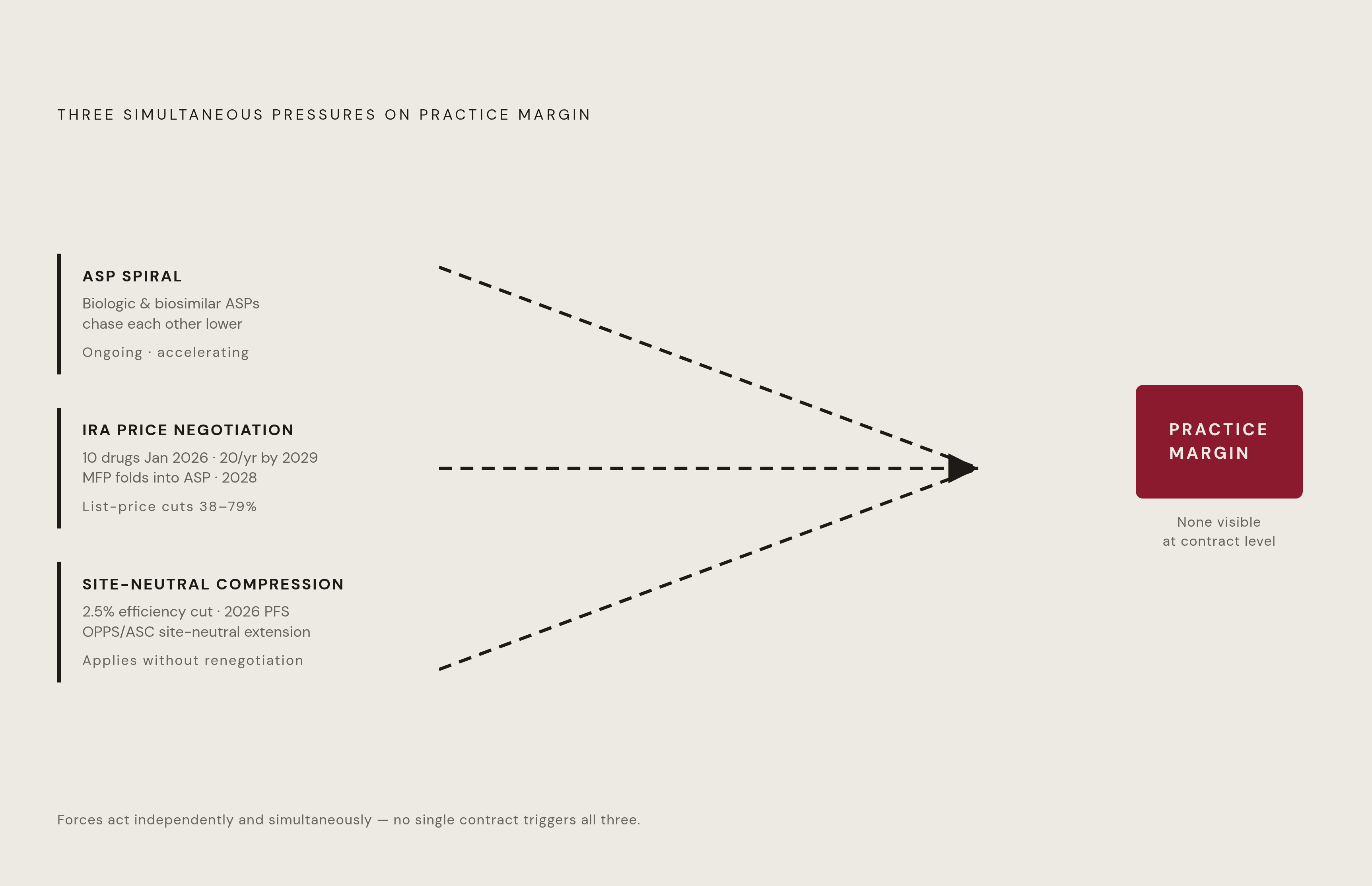
Three forces are running at the same time right now: biosimilar-driven decline in both WAC and ASP, IRA-driven list price cuts with MFP folding into ASP starting in 2028, and site-neutral payment compression on the administration side Drug Patent Watch IRA Price Reset Blog Gabelli Infusion Therapy White Paper 2026 / NHIF. None of them wait for a contract renewal. They just operate, continuously, in the background.
A buy-and-bill practice carries drug acquisition cost as an expense before a dollar of reimbursement ever arrives, so its entire margin rides on the spread surviving intact through accurate billing and close remittance monitoring. Spread erosion is never visible at the contract level. It appears only at the claim level, in the remittance itself, measured against a current drug pricing benchmark. That puts the billing operation, not the contracting team, on the front line of defending it.
A capable infusion billing operation tracks per-drug acquisition cost, follows WAC and ASP updates every quarter, reconciles remittances line by line, flags spread compression by payer and by drug, and raises the flag to the practice before a write-off becomes the quiet default outcome. That kind of claim-level, pricing-aware reconciliation is specialized work, the sort general-purpose RCM tools aren't built around. Spread management in this environment, biosimilar competition pushing from one side, IRA negotiation from another, site-neutral cuts from a third, isn't something a practice can leave to chance Drug Patent Watch IRA Price Reset Blog Gabelli Infusion Therapy White Paper 2026 / NHIF. It needs the same daily discipline that prior authorization and denial management already get, because once the margin loss appears in a revenue report, it's no longer a risk to manage. It's already gone.
Sources
- Drug pricing & reimbursement infusion confusion in 2025 | Turquoise Health Blog
- Microsoft Word - White_Paper_Infusion_Therapy 2026 (003)
- List Price Reductions Will Deflate the Gross-to-Net Bubble–and Threaten Pharmacy and 340B Profits from IRA-Negotiated Drugs
- 247medicalbillingservices.com
- orcm.us
- healthaffairs.org
- drugpatentwatch.com
- qualigenix.com