ASP Plus Methodology for Infusion Biologic Reimbursement
How sequestration and manufacturer pricing cut infusion practice margins below statutory levels.

ASP plus 6% sounds like a simple pricing formula ASPE Medicare Part B Drugs: Trends in Spending and Utilization, 2008-2021. It isn't that simple. For infusion practices billing high-cost biologics, the gap between understanding this system and just muddling through it is the gap between running a stable drug margin and bleeding cash on every vial. ASP Plus Methodology for Infusion Biologic Reimbursement.
The ASP calculation and how the payment formula is built
ASP is not a list price, and it's not some rate a payer and manufacturer sat down and negotiated. It's the mean price paid by all payers for a given Part B drug, rebates and discounts already baked in, recalculated every quarter. CMS publishes it per billing unit, usually per milligram or per milliliter, and that unit-level precision is what eventually turns into the number on a claim.
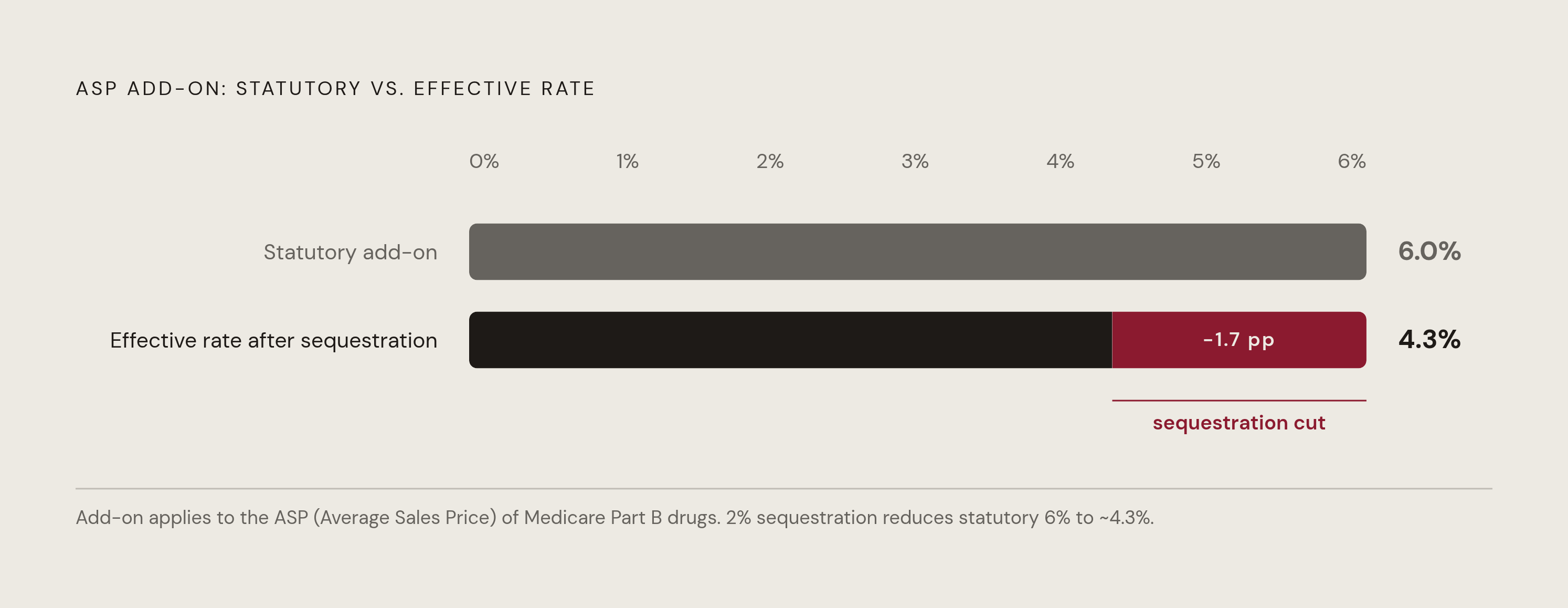
The statutory formula is ASP plus 6% ASPE Medicare Part B Drugs: Trends in Spending and Utilization, 2008-2021. That add-on exists to cover a practice's acquisition cost, storage, and handling, not to function as profit ASPE Medicare Part B Drugs: Trends in Spending and Utilization, 2008-2021. Except most financial models don't account for sequestration, which quietly shaves the real number down to something closer to 4.3% healthaffairs.org ASPE Medicare Part B Drugs: Trends in Spending and Utilization, 2008-2021. That's not a rounding error. Over a year of high-volume infusion billing, the gap between 6% and 4.3% is the difference between a drug that pads the practice's margin and one that barely breaks even healthaffairs.org ASPE Medicare Part B Drugs: Trends in Spending and Utilization, 2008-2021.
There's a second wrinkle: the "lesser of" rule. Since July 1, 2021, CMS pays the lesser of the standard ASP+6% limit or an ASP+6% calculation that excludes certain self-administered products flagged in an OIG study ASPE Medicare Part B Drugs: Trends in Spending and Utilization, 2008-2021. This mostly matters for drugs that come in both an injectable, provider-administered form and a self-administered form sharing the same billing code. Miss that distinction and a practice can badly overestimate what a claim will actually pay.
None of this works without manufacturers reporting honestly and on time. Every Part B drug manufacturer feeds ASP data into CMS's ASP Data Collection System, and they've got 30 days after each quarter closes to do it. The number that eventually becomes a practice's payment ceiling is set entirely upstream, by people who never touch a claim form. Understanding that dependency matters because biologics aren't a side business in Part B; they're the main event: 78.9% of total Medicare Part B drug spending, growing 11.5% a year between 2008 and 2021 ASPE analysis via Acumen. Whatever CMS does with the ASP formula, it's doing to the bulk of what infusion practices bill.
The six-month lag's impact on infusion practices buying drugs today
The lag is what most people underestimate until it costs them money. ASP publishes on a six-month delay, so a drug infused in Q1 2026 gets reimbursed off ASP data from Q3 2025. Practices are buying at today's price and getting paid off yesterday's.
In a flat market, that's a nuisance at worst. When a biosimilar just launched or a manufacturer just cut a deal, prices are moving, and the lag turns into a real margin gap. Net cost recovery, or NCR, is the term for how much of a practice's acquisition cost actually gets covered at reimbursement. When ASP has dropped since the drug was purchased, NCR goes negative. Practices respond by squeezing manufacturers for bigger discounts to close the gap, but those very discounts get reported into the next ASP cycle and pull the published rate down further. It's a loop that feeds itself.
Buy-and-bill makes this worse, not better. A practice buys the drug, administers it, then bills, and if ASP has already fallen below acquisition cost by the time the claim goes out, the loss was locked in the moment the vial was purchased. There's no appeal process for "the market moved." So this isn't a once-a-year lookup. Practices need a standing habit of checking CMS's quarterly ASP payment limit files, because the same J-code can shift meaningfully from one quarter to the next. That lag is also the mechanism that feeds directly into a bigger structural problem, one that's specific to how biosimilars get priced. This lag dynamic is the entry point into the ASP spiral, which the next section addresses directly.
The ASP spiral and why biosimilar competition accelerates it
Small-molecule generics share a billing code with their brand-name counterpart. Biosimilars don't.
That distinction is what sets the spiral in motion. A biosimilar manufacturer prices low to win volume, that low price flows into ASP, and the published reimbursement rate for the biosimilar drops in the following quarters. Provider NCR turns negative, so providers lean on manufacturers for deeper discounts to protect margin, and those discounts get reported right back into the next ASP calculation, pulling the number down again. Round and round. Health Affairs, in an analysis by Hansen and colleagues, warned this cycle could eventually push biosimilar manufacturers out of the market altogether, which would mean less supply and less future biosimilar development, exactly the opposite of what the policy was supposed to encourage.
The 6% add-on makes the squeeze sharper ASPE Medicare Part B Drugs: Trends in Spending and Utilization, 2008-2021. It's a percentage, so as the ASP it's calculated against shrinks, so does the dollar amount a practice actually collects, even though the percentage itself never changes ASPE Medicare Part B Drugs: Trends in Spending and Utilization, 2008-2021. IQVIA data cited in that same Health Affairs piece show that biosimilars typically launch priced at least 25% below their reference product. A 25% price cut on a high-cost biologic is not a rounding error working its way through the system IQVIA.
For billing teams, a biosimilar entering a practice's formulary is a reimbursement event, not just a clinical or purchasing decision. It's a reimbursement event, one that sets off a chain of ASP adjustments that will touch claim payment for quarters to come. Practices that aren't tracking biosimilar launches for their highest-volume J-codes are guessing at their own forward margin. Unlike small-molecule generics, biosimilars receive separate billing codes and therefore separate ASPs, competing as distinct products rather than substitutes that share a code.
The IRA biosimilar add-on boost's partial, temporary offset of the spiral
Congress saw this coming, at least partly. Before the IRA, biosimilars were paid at their own ASP plus 6% of the reference product's ASP ASPE Medicare Part B Drugs: Trends in Spending and Utilization, 2008-2021. Under the enhanced rate, qualifying biosimilars get ASP plus 8% of the reference product's ASP, and because the add-on is calculated off the reference product's ASP rather than the biosimilar's own depressed price, the payment isn't undercut by the biosimilar's lower price AJMC.
That's a real floor, but it's a partial one. The 8% add-on softens the economics without stopping the underlying ASP spiral, it narrows the gap, it doesn't close it AJMC. And the boost has an expiration date built in. It runs for five years, not indefinitely, so building a five-year financial model that assumes this support never ends is a planning error.
At the claim level, this creates a very specific, very avoidable failure mode: billing teams that miscalculate which biosimilars actually qualify for the 8% enhancement, or that apply the wrong reference base, are underpaying themselves on drugs they're already administering correctly AJMC. The clinical work gets done right. The reimbursement gets left on the table. This provision is a bridge, not a destination, and the more disruptive shift arrives once it winds down.
The 2028 MFP integration into ASP and the structural shift it introduces for infusion practices
The 2026 Physician Fee Schedule final rule, issued October 31, 2025 and published in the Federal Register on November 5, 2025, effective January 1, 2026, sets up the next structural change. CMS confirmed that units of negotiated Part B drugs sold at the Maximum Fair Price, or MFP, get folded into ASP calculations starting January 1, 2026.
Standard ASP publication for negotiated Part B drugs will be suspended until generics or biosimilars enter the market, at which point ASP publication resumes.
The ripple effects go beyond Medicare ASPE Medicare Part B Drugs: Trends in Spending and Utilization, 2008-2021. Avalere, 2025, found that over 80% of commercial and Medicare Advantage contracts run at least two years and typically tie drug reimbursement to ASP, so if MFP becomes the new ASP reference for negotiated products, commercial rates could follow downward AJMC. Avalere also flagged that the MFP+6% reimbursement level may accelerate migration away from buy-and-bill toward white bagging or specialty pharmacy distribution for affected drugs ASPE Medicare Part B Drugs: Trends in Spending and Utilization, 2008-2021. Smaller, independent infusion sites carry the most exposure here. Practices with onsite infusion centers and heavy reliance on negotiated drugs face the sharpest margin hit, and consolidation pressure only compounds the strain on community-based independents.
There's political pushback brewing, too. Lawmakers have reintroduced proposals to leave ASP+6% untouched and instead have manufacturers rebate Medicare directly for the MFP gap, though that remains unresolved ASPE Medicare Part B Drugs: Trends in Spending and Utilization, 2008-2021. A King & Spalding analysis from November 2025 found that CMS finalized new documentation requirements around bona fide service fees, requiring manufacturers to show their reasoning on fair market value determinations, though CMS stopped short of mandating a specific FMV methodology. That's one more variable feeding into ASP math that has nothing to do with biosimilar competition and everything to do with contract structuring upstream ASPE Medicare Part B Drugs: Trends in Spending and Utilization, 2008-2021.
None of this is a 2028 problem to defer. Practices should be identifying now which drugs in their J-code mix are negotiation-program candidates, and running the numbers at 106% of MFP before the rule actually bites ASPE Medicare Part B Drugs: Trends in Spending and Utilization, 2008-2021.
J-code mechanics, ASP-based rate translation into claim dollars, and sources of billing errors
All of the ASP math above is theoretical until it turns into a J-code on a claim form. J-codes are the HCPCS Level II codes that put ASP-based payment into practice, each one tied to a specific drug and a specific billing unit, whether that's per milligram or per milliliter. CMS publishes quarterly national payment limits for the commonly used ones based on ASP+6%, and that published number is the ceiling the biller is negotiating against ASPE Medicare Part B Drugs: Trends in Spending and Utilization, 2008-2021.
This is where a correct ASP calculation upstream can still get destroyed by a sloppy claim downstream ASPE Medicare Part B Drugs: Trends in Spending and Utilization, 2008-2021. Unit conversion is a primary driver of high-dollar oncology payment denials: if a physician administers 40 mg of a drug billed "per 10 mg," the correct unit entry is 4. Get that wrong and it's one of the most common drivers of high-dollar denials in oncology and infusion billing alike.
Code sets don't sit still, either. A practice running last quarter's code list can deny a treatment that was administered correctly, purely on a coding technicality.
Waste documentation is its own minefield. Modifier JW exists specifically to report drug discarded from a single-dose vial, and post-payment audits running through 2024 into 2026 are targeting exactly this: dosage accuracy, vial wastage records, and medical necessity documentation for expensive biologics. Then there's J3490, the catch-all code for drugs that don't have their own specific J-code. Claims under J3490 need extra documentation, drug name, NDC, dosage, invoice, because payers have no standard pricing reference to check against, and that absence of a reference point means higher denial risk by default. The lesson across all of it: a perfect ASP calculation upstream is worthless if the claim itself is coded wrong. In 2026 alone, 160 new HCPCS Level II codes were added and 101 deleted, and practices that do not maintain current code sets risk denial on validly administered treatments (orcm.us, AJMC).
Buy-and-bill financial risk as an amplifier of ASP methodology exposure
Buy-and-bill puts the practice's own capital on the line before a single reimbursement dollar arrives. The practice buys the drug at wholesale, administers it, then bills, which means money is at risk well before the claim is even filed.
For high-cost specialty biologics, one denied claim can tie up tens of thousands of dollars in drug cost, and that's not an inconvenience, it's a cash-flow emergency for a practice running on thin margins. The six-month lag makes this sharper still: if ASP at claim time has dropped below acquisition cost because a biosimilar entered the market or pricing shifted during the lag window, that loss is already locked in, with no mechanism to recover it after the fact.
Because the add-on is a percentage of ASP, providers make more in absolute dollars administering more expensive drugs, and when biosimilars compress ASP, they compress the dollar value of that add-on too, turning biosimilar adoption into a financial modeling exercise as much as a clinical one. Stack the 2028 MFP shift on top of that, and drugs selected for negotiation face a double hit, margin compression from 106% of MFP plus continued uncertainty on acquisition costs ASPE Medicare Part B Drugs: Trends in Spending and Utilization, 2008-2021.
Some practices don't even get the choice to run buy-and-bill anymore. White bagging, where a specialty pharmacy ships the drug directly rather than the practice purchasing it, is often not a preference at all: 81% of practices using white bagging do so because payer contracts force it infusioncenter.org. When that happens, the drug margin disappears completely, and the practice is left holding only the administration fee. Site of service adds another layer of exposure. Payer-driven site-of-care migration is compressing the reimbursement differential for common infusion codes by 18% to 22% for freestanding vs. hospital outpatient settings mordorintelligence.com DrugPatentWatch AJMC. Add rising costs, tighter payer rules, and increasing post-payment audit activity through 2026, and the room for error in buy-and-bill has gotten noticeably smaller.
ASP-based reimbursement's interaction with prior authorization and denial risk for recurring infusion treatments
A perfectly calculated ASP rate pays nothing if the prior authorization behind the claim was wrong, expired, or never obtained in the first place.
The trend line isn't encouraging. Experian Health's 2025 State of Claims Report found that claim denial rates climbed from 30% in 2022 to 38% in 2024, and rose over 11% further in 2025 2025 State of Claims Report by Experian Health CMS AJMC. Authorization is getting harder, not easier. It's getting harder, at exactly the moment infusion volume for biologics keeps climbing.
Infusion therapy adds its own layer of PA complexity, since a denial can hinge on any mismatch in medication, dosage, frequency, or duration, and every one of those dimensions maps straight onto the J-code unit and frequency data that ASP-based payment depends on. Biologic agents like infliximab, billed under J1745, and abatacept, billed under J0129, commonly require documented proof of a failed lower-cost therapy before authorization even gets granted. That paperwork has to be sorted before the patient sits in the infusion chair, not scrambled together afterward. Medical necessity documentation carries the same weight, payers frequently want evidence that less invasive options were tried and failed, and without that already in the chart at the authorization stage, the claim is set up to fail before it's even submitted.
CMS has moved to tighten the process from its end. That helps with speed and transparency. It does nothing to reduce the underlying clinical documentation burden practices still have to produce.
An authorization for a different dose or frequency than what actually gets billed functions as no authorization at all, regardless of how cleanly the ASP math was done. Revenue cycle control has to start at scheduling, because by the time a claim goes out the door, the authorization gaps that will trigger denial are already baked in, and no amount of downstream ASP accuracy fixes that. CMS finalized a rule in January 2024 mandating response time ceilings of 7 days standard and 72 hours expedited, and denial reasons on denied PAs effective January 1, 2026, and requiring a Prior Authorization API for electronic PA submission by January 1, 2027, changes that reduce some friction but do not eliminate the clinical documentation burden.
Reform
Every piece of this system points toward the same tension. ASP-based reimbursement was built to track a real market price, rebates and discounts included, updated regularly enough to stay honest. But the six-month lag, the biosimilar spiral, and now the MFP integration are pulling that design in a direction where the rate a practice gets paid has less and less to do with what the practice actually paid to acquire the drug.
Post-IRA, qualifying biosimilars are paid at biosimilar ASP plus 8% of the reference product's ASP, with the add-on calculated against the reference product's ASP rather than the biosimilar's lower ASP, providing a partial floor AJMC. The MFP shift starting in 2026, with full effect landing by 2028, replaces ASP+6% with a flatter, lower-margin structure for an expanding list of negotiated drugs, and the legislative proposals aimed at softening that landing haven't gone anywhere yet ASPE Medicare Part B Drugs: Trends in Spending and Utilization, 2008-2021. Meanwhile the basic mechanics, J-code accuracy, modifier use, prior authorization synchronization, only get less forgiving as denial rates climb and audits intensify.
None of this waits for a policy resolution. Practices purchase drugs at current market prices but are reimbursed at a rate set from prices reported two quarters prior. SOURCE PAGES (what the pages behind the outline's links say).
Sources
- Reforming Average Sales Price-Based Reimbursement For Infused Biosimilars | Health Affairs
- aspe.hhs.gov
- ASP Reporting | CMS
- Medicare Part B Pricing Changes Aimed at Encouraging Biosimilar Use Begin | AJMC
- Observations Regarding the Average Sales Price Reimbursement Methodology | AJMC
- 2026 Physician Fee Schedule Final Rule Changes to ASP Calculation and Reporting Policies and Other Drug Payment Policies
- 2026 MPFS Rule: Part B MFPs Included in ASP, but Questions Remain | Avalere Health Advisory
- Biosimilar Reimbursement Models: The Definitive Analyst’s Guide to Buy-and-Bill, PBM Dynamics, ASP Mechanics, and the Structural Forces Shaping Biologic Market Access - DrugPatentWatch – Transform Data into Market Domination